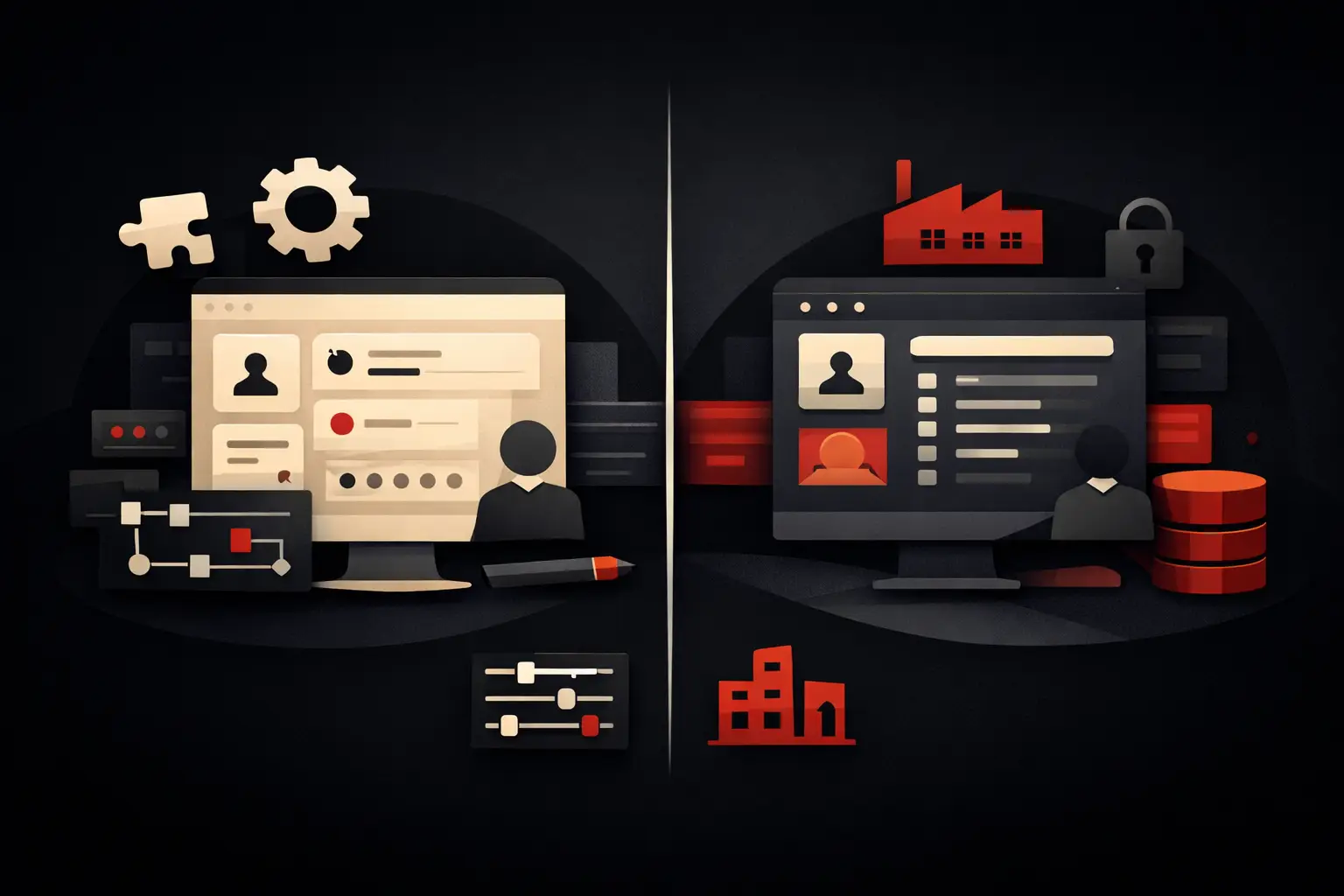
Custom CRM vs. Standard CRM: Which Is the Better Choice?
Custom CRM vs. standard CRM: compare costs, timelines, integrations, and ROI to choose the solution that fits your company’s processes and supports better growth.
A salesperson updates the CRM, the administration team exports data to Excel, customer care checks another tool, and management receives reports prepared manually at the end of the month. In this scenario, the comparison between custom CRM vs. standard CRM is not simply about choosing software: it is about the operating cost of fragmentation and the company’s ability to grow while maintaining control.
A standard CRM can be an excellent starting point. But as processes, roles, and data become more complex, adapting daily work to the platform can cost more than designing a solution that fits real operations. The right choice depends on the level of complexity, the objectives, and the value the company wants to get from sales, support, and automation.
Custom CRM vs. Standard CRM: The Real Difference
A standard CRM is a ready-to-use platform that can be configured through fields, pipelines, modules, and integrations available in its ecosystem. It is designed to cover common needs: contact management, sales opportunities, activities, email, reporting, and basic automation. The advantage is clear: faster implementation and generally lower upfront investment.
A custom CRM, on the other hand, is built around business workflows. It does not start with a list of features to activate, but with operational questions: How does a lead come in? Who qualifies it? What information is needed before preparing a proposal? How does the process move from sales to production, logistics, or after-sales? Which data should each role be able to see, and which actions should happen automatically?
The difference, then, is not between a simple solution and a complex one. It is between software that requires the company to adapt and a tool that makes the way the company creates value more efficient.
When a Standard CRM Is the More Efficient Choice
Choosing a standard CRM makes sense if the sales process is straightforward, the team is small, and existing features already cover the company’s needs. For an SME that needs to centralize contacts, organize follow-ups, and gain visibility into its pipeline, a ready-to-use platform can deliver immediate improvements.
It is often the right choice when the main priority is to validate a sales method, too. If the process is not yet defined, investing in custom development right away risks locking in procedures that may change within a few months. First clarify the operating model, then decide which parts warrant dedicated digitization.
A standard CRM remains cost-effective when only a few well-established integrations are needed. If the company already uses widely adopted tools for email marketing, invoicing, or calendars, it can achieve good data continuity with limited configuration.
The critical point comes when customizations start to multiply. Additional fields, alternative workflows, automations built with external connectors, manual exports, and parallel dashboards can seem like minor compromises. But once you add up the hours of work, errors, and maintenance, they become a fragile and costly structure.
When a Custom CRM Creates a Measurable Advantage
A custom CRM becomes strategic when customers go through a process that does not fit a standard sales pipeline. This applies to companies with complex quotes, variable price lists, multiple locations, agent networks, technical support, recurring orders, document management, or handoffs between departments.
Consider a B2B company that receives inquiries through its website, at trade shows, from agents, and from partners. The lead needs to be qualified, assigned by geographic area, enriched with external data, turned into a proposal, and then connected to production, technical documentation, and invoicing. In a standard CRM, each step may be manageable. But if information has to be duplicated across systems and staff have to remember manually what to do, the process remains dependent on individuals.
In a custom CRM, the platform can automatically assign the contact, check for missing data, generate tasks, create documents, update order status, and alert the next department. The result is not just greater speed: it is reduced operational variability. Every case follows clear rules, each manager sees what they need, and management has access to more reliable data.
Signs That You Need a Tailored Solution
A custom CRM should be a priority to consider when at least some of these conditions apply:
- the team uses Excel spreadsheets, chats, and email inboxes to work around platform limitations;
- customer data needs to move between sales, administration, operations, and support;
- reports and KPIs require manual exports or frequent reconciliation;
- existing automations do not cover exceptions, approvals, or specific business rules;
- growth in inquiry volume increases administrative work faster than revenue.
These signs do not automatically mean that a custom project is necessary. They do indicate, however, that the problem is no longer contact management: it is process architecture.
Costs, Timelines, and ROI: The Comparison That Really Matters
Upfront cost is the first factor that leads many companies to choose a standard CRM. The monthly subscription is predictable, and implementation can be quick. A custom project, by contrast, requires analysis, design, development, testing, training, and post-launch improvements. It would be misleading to present it as the less expensive option in the short term.
But the right comparison goes beyond the license price. You need to calculate the total cost of operations: hours spent entering the same data multiple times, opportunities lost because of late follow-ups, quoting errors, monitoring tasks, additional software, and dependence on key people who know undocumented exceptions.
The ROI of a custom CRM can be measured when these costs fall and operational capacity increases without requiring the internal team to grow proportionally. If an automation saves ten minutes of work on every inquiry and the company handles hundreds of inquiries a month, the impact becomes tangible. If an up-to-date dashboard makes it possible to act sooner on stalled deals or at-risk customers, the value also flows through to revenue.
Timelines depend on the project’s scope. A standard platform can be up and running in days or weeks if the data is organized and the team is ready to adopt it. A custom CRM takes longer, but it does not necessarily have to be built all at once. The most effective approach is modular: first, the workflow that causes the most waste; then the integrations; and finally, advanced analytics or AI.
The Hidden Risk: Customizing Without Designing
Not every custom CRM improves efficiency. Software built to replicate every internal habit without questioning unnecessary steps can digitize disorder instead of solving it. Technology does not automatically fix a confused process: it just makes it faster at producing data of little value.
That is why the analysis phase is crucial. You need to map roles, data sources, approval steps, exceptions, and KPIs. It is important to distinguish what represents a real competitive advantage from what exists only out of habit. A good CRM project reduces clicks, eliminates redundancies, and makes important decisions traceable.
Interface design also has an operational impact. If salespeople and staff see the CRM as a bureaucratic obligation, data quality suffers. If screens show information relevant to each role and make the next action immediately clear, adoption increases. In this context, premium design means clarity and speed of use.
How to Choose Without Holding Back Growth
The useful question is not which CRM has the most features. It is which system allows your company to acquire, manage, and grow customer relationships with fewer manual steps and greater control. A standard CRM is suitable when common processes need discipline. A custom CRM is the right fit when the process itself is part of the value offered to the market.
A practical assessment starts with a high-frequency workflow: a quote request, order management, contract renewal, or after-sales support. Measure how many people are involved, how many tools are used, how much information is re-entered, and how long it takes for the customer to receive a response. That workflow shows exactly where the cost of inefficiency arises.
For many SMEs, the best choice is neither ideological nor permanent. It could be a well-configured standard CRM today and a custom evolution tomorrow. Or a custom system integrated with platforms that are already working well. The goal remains the same: turn data and processes into a measurable advantage without adding unnecessary complexity.
Before choosing a platform, ask yourself what work should no longer exist six months from now. The answer could be the start of a project that does more than organize contacts: it makes the company faster, more predictable, and ready to grow.
Ready to bring your ideas to life?
Request a free, no-obligation consultation. Let's talk about your project.
Request a consultation