Data integration: fewer errors, more control
Data integration connects CRM, ERP, e-commerce and operational tools: less manual work, reliable data and faster decisions for sustainable growth.
A sales representative updates the CRM, the administration team copies the order into the ERP, the warehouse receives a file a few hours later, and the customer asks for support while nobody has the complete picture. It is not a problem of the team’s commitment: it is the hidden cost of missing or poorly designed data integration.
When information lives in separate tools, every manual handoff slows operations, creates conflicting versions of the same reality and makes decisions less reliable. For an SME, the result is not just internal inefficiency: it means slower quotations, order errors, reactive rather than proactive customer care, and reports that take days to prepare.
What data integration really is
Data integration is the process of collecting information from different software, transforming it and making it available in the right place at the right time. It can connect CRM, ERP, e-commerce, accounting software, production management systems, booking systems, marketing platforms, mobile apps and proprietary databases.
The point is not to make two applications communicate just because it is technically possible. The point is to ensure that an operational event triggers the right action without requiring copies, repetitive checks or unnecessary manual intervention.
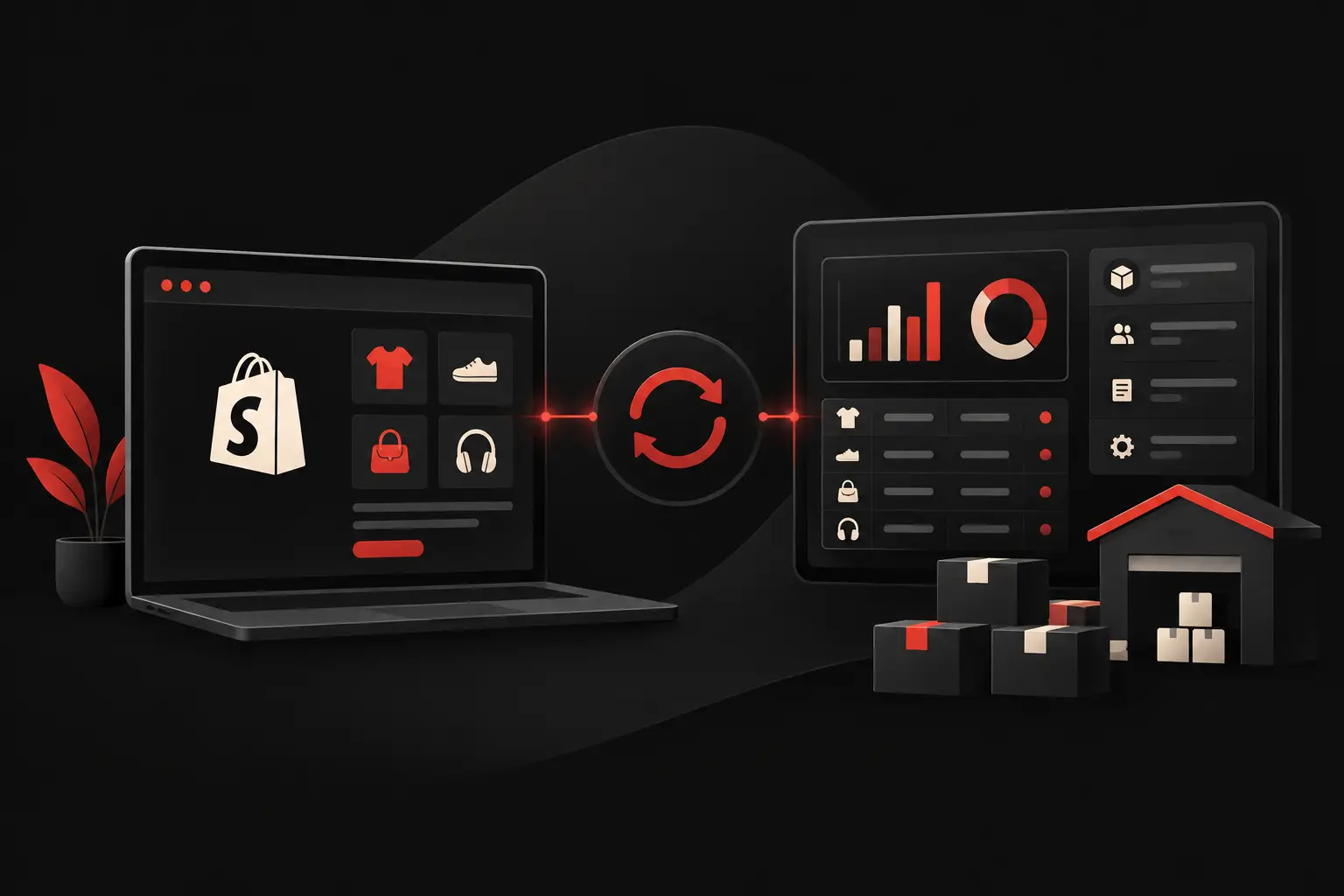
For example, when a new order comes in through e-commerce, the flow can create or update the customer in the CRM, check availability and commercial terms in the ERP, send the request to the warehouse, produce the necessary documents and update a management dashboard. Every company, however, has different rules, exceptions and responsibilities. That is why effective integration does not start with a connector chosen from a catalogue, but with an understanding of real processes.
Integration, migration and centralisation are not the same thing
These concepts are often conflated, creating a risk of choosing the wrong solution. A migration transfers data from one system to another, usually when replacing software. Integration, by contrast, keeps systems connected and aligned over time.
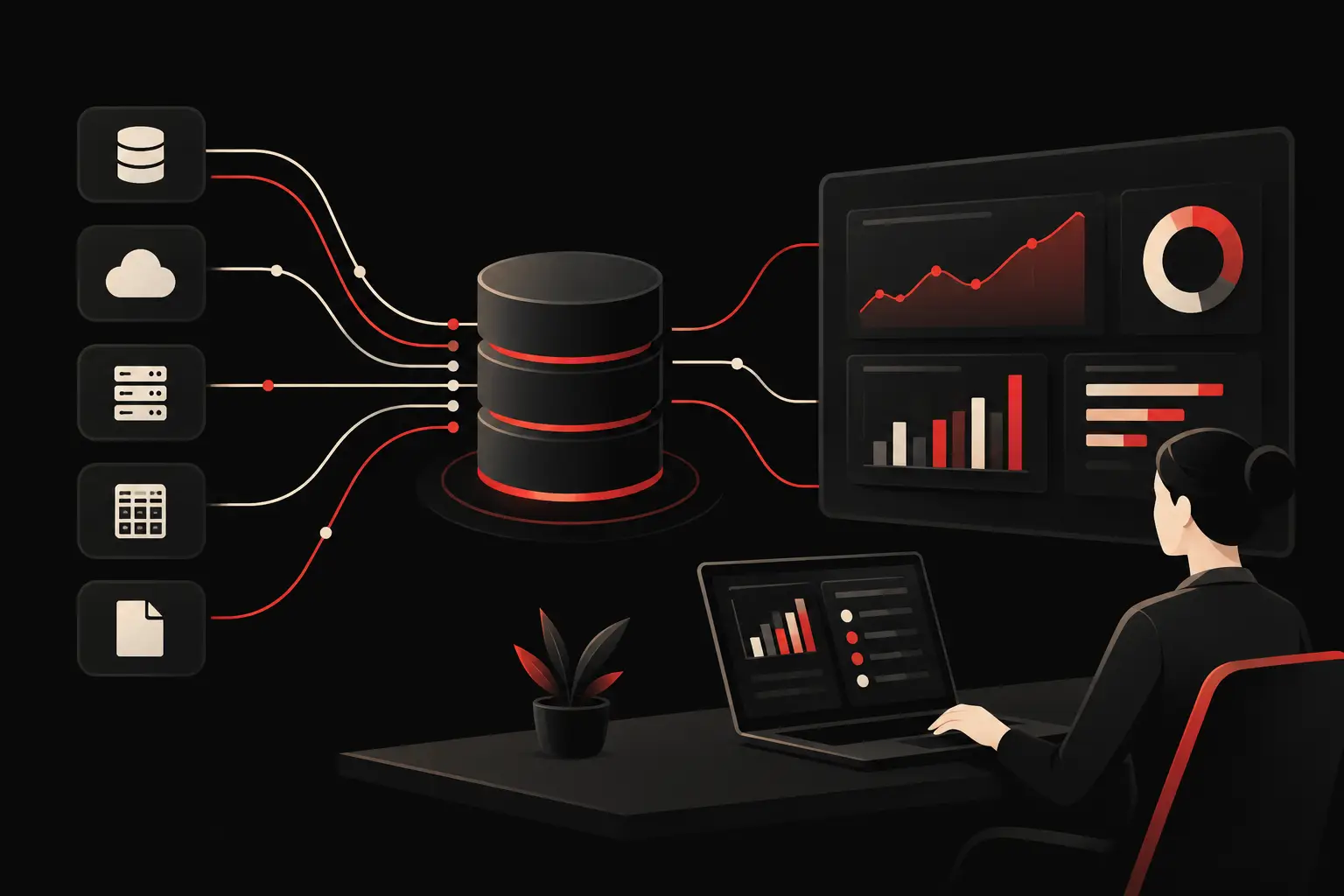
Centralising can mean building a shared database, a data warehouse or a dashboard that aggregates information from multiple sources. It is useful for analysis and oversight, but it does not necessarily replace operational automation. A dashboard that displays orders does not stop someone from having to re-enter them into three different platforms.
In some cases, a single, targeted integration is all that is needed. In others, especially when a company grows across channels, locations or product lines, a more articulated architecture is needed: connected systems, clear synchronisation rules and an authoritative source for every critical piece of data.
Where data integration creates measurable value
The most obvious benefit is the reduction of manual work. But focusing only on time saved means underestimating the impact. Connected data changes how quickly a company sells, delivers a service and handles exceptions.
In sales, a CRM integrated with quotations, orders and purchase history makes it possible to see real opportunities, margins and deal status without chasing information across emails and spreadsheets. The team can spend more time building relationships and less time reconstructing context.
In customer care, an agent can check an order, shipment, payments, previous requests and customer preferences on a single screen. The difference can be measured in response quality, handling times and the ability to spot problems before they turn into complaints.
For operations and administration, alignment between sales, warehouse, suppliers and invoicing reduces transcription errors and makes responsibilities traceable. KPI dashboards also become more credible: when data comes from consistent sources and follows shared definitions, management can act on the numbers instead of debating whether they can be trusted.
Signals that indicate a concrete priority
Integration deserves attention when the cost of fragmentation exceeds the cost of the project. Some signals are particularly clear:
- the same customer, product or order is entered multiple times in different software;
- the team uses Excel files as a permanent bridge between departments or platforms;
- reports require manual data exports, cleaning and recurring checks;
- orders, availability or work statuses differ depending on which tool is consulted;
- key people become bottlenecks because they know undocumented steps.
Not every one of these symptoms calls for a complex programme straight away. However, ignoring them as volumes, channels and headcount grow means cementing operational debt that will become more expensive to fix.
How to design data integration that can support growth
Technology comes after the process. Before choosing APIs, middleware, low-code automation or custom development, it is essential to define what needs to happen and why. A well-designed project starts with high-frequency or high-risk use cases: order intake, availability updates, customer onboarding, after-sales support, renewals and intervention planning.
For each flow, clarify the source system, the system receiving the data, the transformation rules and the data owner. If a product code changes in the ERP, for example, should that value propagate to e-commerce? How often? What happens if the product does not exist or a required field is empty?
These questions may seem technical, but they are business decisions. Without explicit answers, automation reproduces existing ambiguity at greater speed.
Real-time or scheduled synchronisation?
Not everything needs to move in real time. For fast-moving product stock or payment status, a delay of a few minutes can cause operational or commercial problems. For consolidating analytical data, on the other hand, an overnight update may be more than sufficient and less costly to manage.
The choice depends on the impact, volume and criticality of the data. Real-time integrations offer responsiveness, but require greater attention to service availability, error handling and monitoring. Scheduled flows are often simpler and more sustainable, provided the delay is compatible with the process.
Another issue is the direction of synchronisation. Two systems that update each other may seem like a complete solution, but become risky when there is no authoritative source. If both the CRM and ERP can modify customer records, which data takes precedence in the event of a conflict? Setting a clear rule avoids duplicates and silent overwrites.
APIs, automation and custom software: which approach to choose
APIs are interfaces that allow software to exchange information in a structured way. If the tools in use expose them and the flow is straightforward, they can form the basis of effective integration.
Automation platforms are suitable for quick connections, notifications, standard workflows and processes of limited complexity. They are useful for validating a need or speeding up non-critical tasks. Their limitations emerge as exceptions, volumes, calculation logic, security requirements or maintenance needs increase: a poorly governed chain of automations can become a new weak point.
Custom development makes sense when the process represents a competitive advantage, involves legacy systems, requires specific logic or needs precise control. A tailor-made integration layer can handle queues, automatic retries, validations, event tracking and control dashboards. It is not always necessary, but it is often the choice that prevents strategic processes from being adapted to the limitations of generic tools.
Security, quality and monitoring: the unseen part
An integration is not complete when data starts flowing. It must be observable: whoever manages the process needs to know whether a flow succeeded, where it stopped and how to recover from an error without manually reconstructing the entire operation.
Event logs, alerts for anomalies, rules for retrying sends and procedures for handling exceptional cases are essential. When personal or financial data is involved, permissions, minimisation of shared information, protected credentials and access traceability also become central.
Data quality must be addressed before and during the project. Duplicate records, inconsistent codes and freely completed fields compromise any connection. Sometimes the first useful action is not to create a new automation, but to define simple standards for customers, products, work statuses and data ownership.
Measuring the return on integration
A project should be assessed using indicators tied to the operational objective, not simply by the number of connected software systems. If the goal is to speed up order processing, KPIs might include the average time from sale to processing, the percentage of orders handled without manual intervention and the number of data-entry errors.
If the goal concerns customer care, relevant measures include first-response time, first-contact resolution and the number of reopened requests. For management, the time required to produce reliable data on sales, margins, pipeline or campaign performance also matters.
Graffico approaches these projects by starting with the result to be achieved and translating it into flows, tools and verifiable metrics. Because integrating data does not mean adding technology: it means removing friction from a process that needs to create value every day.
The first useful step is to choose a flow that currently requires copying, checking or chasing between departments and measure its real cost for a month. Once that cost is visible, it becomes much easier to decide which integration to build and what priority to give it.
Ready to bring your ideas to life?
Request a free, no-obligation consultation. Let's talk about your project.
Request a consultation