When to choose Shopify or custom
When should you choose Shopify or a custom solution? Find out which option makes sense based on costs, processes, scalability, margins, and operational control.
The right question isn’t which platform is best overall. The right question is when to choose Shopify or a custom solution based on your company’s operating model. An e-commerce business rarely fails because of its visual theme or the platform itself. It fails when the tool can’t support real processes, forces the team to work manually, limits margins, and slows growth.
For an SME, an expanding brand, or a company with non-standard commercial requirements, choosing between Shopify and a custom solution isn’t a technical preference. It’s a structural decision. It affects launch speed, future costs, integrations, automation, data control, and the ability to adapt the system to the business—not the other way around.
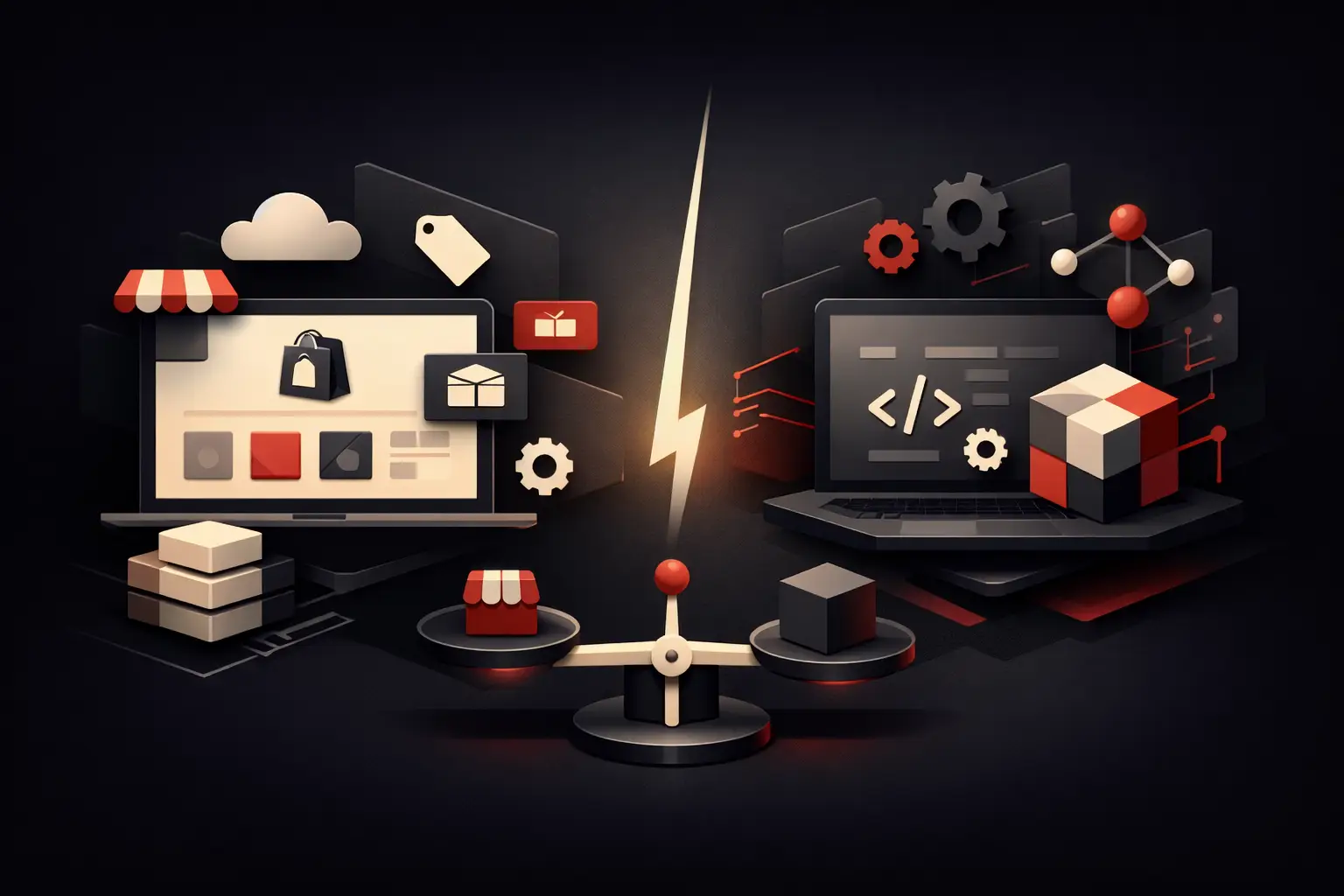
When to choose Shopify or custom: the real difference
Shopify is an excellent platform when you need to launch a reliable e-commerce store quickly, with ready-made features and simplified management. It reduces initial complexity and lets you focus on your catalog, marketing, and sales. For many companies, it’s the most efficient choice during validation or the early stages of growth.
A custom solution starts from the opposite premise. It doesn’t ask the company to adapt to a predefined structure; instead, it builds technology around specific processes, commercial rules, internal roles, and data flows. This approach requires more analysis, more design, and a larger investment, but becomes strategic when e-commerce is no longer just a sales storefront and instead becomes a central part of operations.
The difference, then, isn’t between a simple solution and an advanced one. It’s between standardization and alignment with the business model.
Shopify works very well when complexity is still under control
If you sell a relatively straightforward catalog, with clear pricing rules, standard order management, and a team that doesn’t need highly customized processes, Shopify is often the smartest choice. It shortens time to launch, simplifies maintenance, and provides a stable environment without having to build everything from scratch.
It’s especially suitable when the business needs speed. For example, if you’re launching a new brand, want to test a market, need the e-commerce channel to start generating revenue quickly, or have an in-house team that isn’t set up to manage a complex platform. In these scenarios, paying for a custom solution too early risks tying up budget that would be better spent on acquisition, content, CRO, and operations.
Shopify also makes sense when your competitive advantage doesn’t lie in proprietary technology, but in your offering, positioning, brand, or marketing. If your processes are compatible with the platform’s logic, forcing a custom project can be a mistake. Not because custom doesn’t work, but because it would be disproportionate to the problem you need to solve.
When Shopify starts to become a limitation
The critical point comes when e-commerce stops being an isolated channel and connects to more complex processes. Multiple price lists, customer-specific commercial terms, B2B workflows, internal approvals, product configurations, special logistics rules, ERP or CRM synchronization, operational dashboards, and post-sale automation. At this point, the standard platform often starts to require compromises.
The first sign is manual work. If the team copies data from one system to another, manually corrects orders, checks exceptions outside the platform, or uses spreadsheets to make up for what e-commerce can’t handle, the problem isn’t organizational. It’s structural. You’re already paying the price of misaligned technology.
The second sign is dependence on apps and workarounds. Extensions can be useful, but when there are too many, they increase recurring costs, the risk of incompatibility, data fragmentation, and rigidity that makes future development harder. At first, it seems cheaper. Over time, the opposite can be true.
The third sign is loss of control. If every significant change requires workarounds, if data isn’t centralized, or if the customer experience has to adapt to the system’s limitations instead of the commercial strategy, then the platform is holding back margins and scalability.
When to choose Shopify
Shopify makes sense when the top priority is to execute well, quickly, and with manageable complexity. It’s the right choice if you have a standard catalog, simple processes, non-critical integrations, and need a stable ecosystem without building proprietary infrastructure.
It also makes sense when the business still needs to validate its numbers and scenarios. If you don’t yet have enough data on conversion, average order value, retention, or actual demand, starting with a leaner solution is often a rational decision. Validate the model first, then work out where customization is needed.
For many companies, Shopify is also an excellent foundation for growth, as long as you know where to draw the line. The problem isn’t choosing Shopify. The problem is using Shopify in contexts that call for a system more closely aligned with the company’s real workflows.
When to choose a custom e-commerce solution
A custom solution becomes worthwhile when e-commerce is part of a broader operating ecosystem and needs to connect with specific processes. If you sell through complex commercial networks, manage differentiated price lists, have intricate B2B requirements, or need to bring multiple departments together in a single workflow, custom stops being a luxury and becomes a lever for efficiency.
The same applies if your competitive advantage depends on how you sell, not just what you sell. Think of configurators, dynamic quoting, approval workflows, private portals, shopping experiences tailored to customer type, and automations that reduce handling times and human error. In these cases, the platform must adapt to the process; otherwise, the process loses value.
A custom e-commerce solution also makes sense when the company wants to centralize data and control—not just sales, but orders, customer service, logistics, administration, marketing, and KPI analysis. If the goal is to make the business more predictable and less dependent on manual tasks, tailored technology enables a more efficient design for the entire operating system.
The real comparison: upfront cost versus operating cost
Many comparisons between Shopify and custom stop at the initial budget. That’s understandable, but it’s an incomplete view. Shopify costs less at the start. Custom costs more at the start. That’s obvious. What’s often not properly assessed is the operating cost that builds up over time.
If a low-cost platform requires manual management, additional tools, constant fixes, disconnected processes, and workarounds that slow the team down, the initial savings can quickly disappear. Not always in a way that’s visible in the technical budget, but in internal time, errors, missed opportunities, and coordination costs.
On the other hand, a custom solution designed without a genuine analysis of processes can become oversized and inefficient. Realism matters here, too. Not everything needs to be built from scratch. Build only what delivers a tangible advantage, control, or measurable automation.
The right choice isn’t the one that costs less today. It’s the one that creates less friction and more value over the next 24–36 months.
How to decide without making the wrong investment
To understand when to choose Shopify or custom, it helps to look at four areas: catalog complexity, internal workflow complexity, integration needs, and the economic impact of manual work. If these four variables are low or moderate, Shopify is often enough. If they all grow, custom starts to offer a clearer ROI.
Here’s another useful criterion: if your team works well despite the platform, you’re compensating for a technological limitation with human effort. That isn’t scalable. If, instead, the platform makes work faster, more accurate, and more measurable, you’re building an asset.
The most clear-sighted companies don’t just ask which system can sell online. They ask which system reduces friction, increases control, and supports growth without multiplying complexity. That’s a decisive difference.
The best choice is the one that fits your stage
Not every company needs to start with a custom solution. Not every company should stay on Shopify. The right choice depends on the stage of the business and the operational demands the e-commerce operation needs to support.
If you need speed, standardization, and time to market, Shopify may be the most efficient choice. If you need deep control, automation, system integration, and non-standard commercial processes, a custom solution is often the more solid path. In projects like these, partners such as Graffico focus on exactly this: turning business complexity into measurable digital tools without building more than necessary.
The best technology isn’t the most famous or the most flexible on paper. It’s the one that reduces waste, supports growth, and adapts to the way your company actually sells, operates, and scales. From there, every decision becomes easier.
Ready to bring your ideas to life?
Request a free, no-obligation consultation. Let's talk about your project.
Request a consultation