Custom Ecommerce for SMEs: When Is It Worth It?
Custom ecommerce for SMEs: when it really makes sense, which problems it solves, and how it improves margins, processes, control, and growth.
An online catalog that sells poorly rarely has just one problem. Usually, several issues add up: slow order management, complex price lists handled poorly, promotions that are difficult to configure, stock that is not up to date, and customer service chasing down scattered information. This is where custom ecommerce for SMEs stops being an aesthetic choice and becomes an operational decision.
For many companies, the point is not to “open an e-commerce store.” It is to build a sales channel that fits real processes, real margins, and real constraints. An SME working with sales networks, reserved price lists, technical catalogs, configurable products, or B2B workflows does not have the same needs as a brand selling ten standard SKUs to end consumers. Using the same structure for different cases almost always leads to inefficiencies, manual exceptions, and loss of control.
When custom ecommerce for SMEs makes sense
There is no need to start from scratch with every project. In some cases, a well-configured standard platform is enough. The problem arises when the business grows and the system can no longer handle the complexity.
If the team has to correct orders manually, align stock across multiple channels, apply discounts outside the platform, or answer the same sales questions every day, the cost is not just technical. It is economic. Every manual step consumes time, increases the risk of error, and slows scalability.
Custom ecommerce for SMEs makes sense above all when the sales model is not straightforward. Think of companies managing price lists for agents and resellers, differentiated access for business customers, order approval workflows, quotes that can be converted into purchases, quick reorders, customizable products, or integrations with ERP and CRM systems. In these scenarios, forcing the business into a standard template is a false economy.
The right criterion is not “custom or not custom.” It is this: how much does it cost today to adapt people’s work to a system that was not designed for your process?
The real advantage is not design, but control
A custom project is often associated with more polished graphics. That is an advantage, but it is not the decisive one. The main value is control over the operational workflow.
When ecommerce is built around a company’s processes, online sales do not remain an isolated channel. They become an integrated part of the sales operation. Orders, availability, customer records, payment terms, support tickets, and performance data start communicating in an orderly way.
This changes day-to-day work. Sales staff see cleaner information, administration deals with fewer exceptions, the warehouse receives more reliable data, and management can review more useful KPIs. The customer experience improves too, but as a result of a better structure, not simply because of a well-designed homepage.
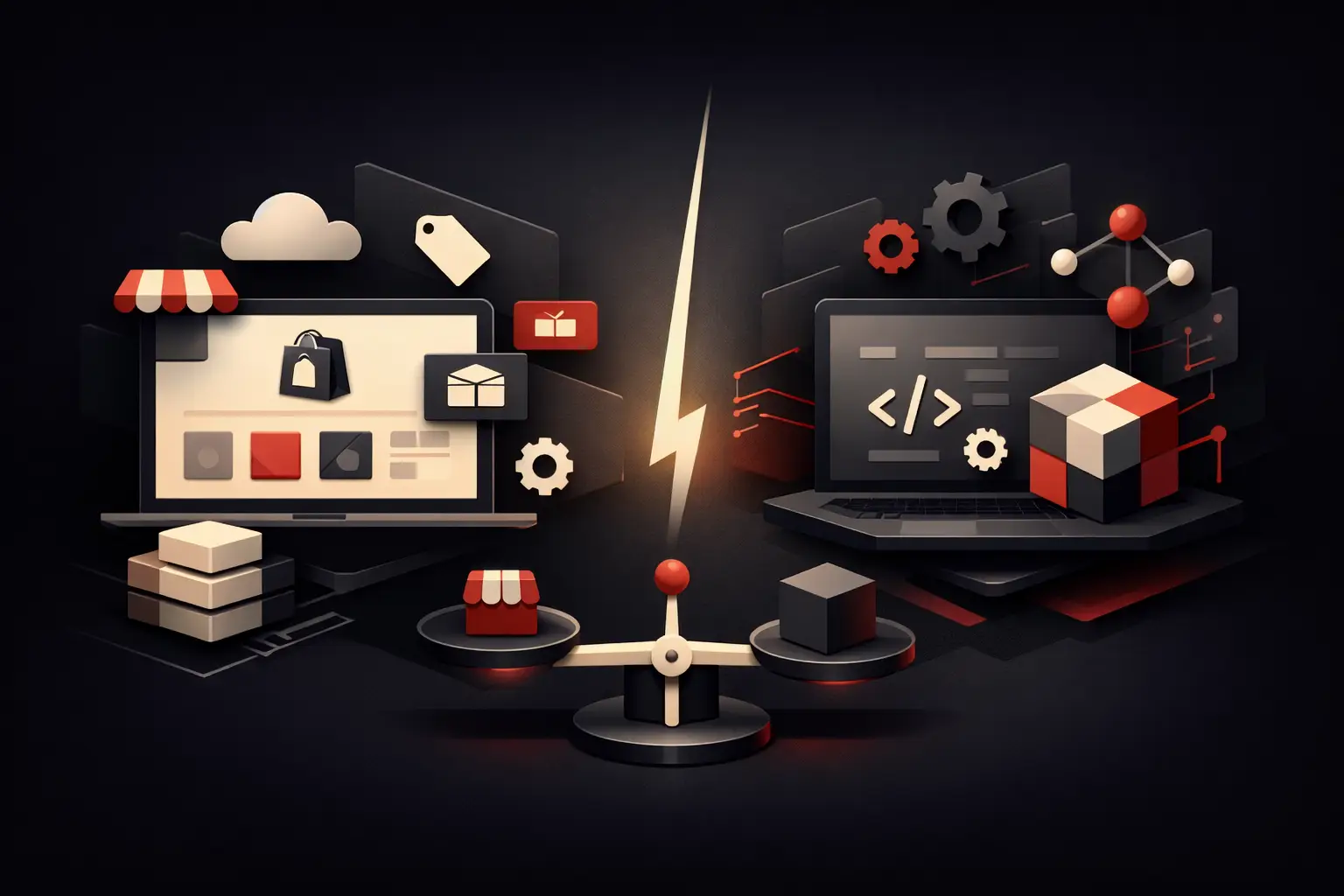
Standard vs. custom: the difference lies in the exceptions
Standard platforms work well when the business is relatively simple. They have lower upfront costs, faster setup times, and often a very broad plugin ecosystem. For many microbusinesses, they are a sensible choice.
For a well-established SME, however, the problem emerges in the exceptions. And exceptions are precisely what determine whether the system is sustainable. Different pricing rules by area or customer, special bundles, recurring orders, sample management, warehouse-specific availability, internal approval workflows, integrations with legacy software: every deviation from the standard case introduces workarounds.
At first, they seem manageable. Then they turn into dependence on Excel spreadsheets, duplicate tasks, staff who know undocumented shortcuts, and processes that hold up only as long as volumes remain manageable. Beyond a certain point, a customized standard system risks costing more than a solution designed properly from the outset.
Where custom solutions generate ROI
Talking about digital ROI without getting into the details is of little use. For custom ecommerce, returns do not depend solely on increased sales. Often, they come first from reducing inefficiencies.
The first area is operational time. If an order comes in with the correct pricing, availability, and commercial terms already applied, the team has less work to do. Fewer corrections mean fewer hours spent on low-value tasks.
The second area is accuracy. Correct integrations with the ERP, CRM, or warehouse reduce discrepancies that cause delays, credit notes, disputes, and internal stress. This has a direct impact on margins, not just on the organization.
The third area is conversion. A catalog designed around your purchasing process reduces real friction. In B2B, for example, customers are not looking for entertainment. They want speed, clarity, availability, dedicated terms, and the ability to reorder without wasting time.
The fourth area is scalability. As volumes increase, a well-designed system can absorb growth without immediately requiring new people to handle avoidable complexity. This is where technology becomes a structural lever.
What an effective project should really include
A good custom ecommerce site is not a storefront with a few extra features. It is a system built to support a commercial model. That is why the most important phase is not development itself, but planning and design.
You need to map the entire order cycle: from how a customer discovers a product to how after-sales service is handled. You need to understand where exceptions arise, which data needs to flow, which tasks are repetitive, and which dependencies are currently holding the team back.
In many cases, the features that really make a difference are not the ones visible on the homepage. They include an advanced customer area, personalized price lists, commercial rules engines, product configurators, order dashboards, contextual email automations, smart replenishment, integration with internal systems, and KPI tracking.
Design matters too, but it should be treated as part of the business outcome. A premium interface is not just about “looking good.” It helps reduce uncertainty, speed up the purchasing journey, and align brand perception with the company’s real value.
Risks to avoid with custom ecommerce for SMEs
The term “custom” can be misunderstood. It does not mean building everything without a method. Nor does it mean developing features just because they “might be useful.” A poorly executed custom project creates the same problems as a standard system that has been forced to fit, but at a higher cost.
The first risk is digitizing an inefficient process without questioning it. If the upstream workflow is confusing, the ecommerce site will inherit that confusion. The second is designing without clear metrics. If you do not first define what you want to improve—processing times, average order value, repeat purchase rate, error reduction, or profitability—it will be difficult to measure the outcome.
The third risk is ignoring ongoing improvements and maintenance. Ecommerce is not a static asset. Catalogs, commercial rules, campaigns, integrations, and customer expectations change. You need a clean, documented technical foundation designed to evolve without becoming fragile.
How to tell if you are ready
Not all SMEs need the same level of customization. The useful question is not whether your business is “big enough,” but whether its current complexity is already generating hidden costs.
You are probably ready if online sales are strategic but the team is still manually firefighting problems. If you sell under non-standard commercial rules. If you have systems that do not communicate with one another. If growing the digital channel would require new hires simply to manage operational disorder. If your positioning is stronger than what the digital experience conveys.
In these cases, custom is not a luxury. It is a way to remove structural friction and turn the ecommerce channel into a more efficient sales infrastructure.
The partner matters, not just the technology
The quality of the outcome depends greatly on how the problem is understood. An effective technical partner does not start with the theme or the CMS. They start with business priorities, bottlenecks, margins, the operating cycle, and growth objectives.
This advisory approach is what distinguishes a useful project from one that has simply been published online. Companies like Graffico do their best work when they combine development, design, and process engineering, because the value of ecommerce is not measured by the number of features installed, but by its impact on day-to-day work and commercial performance.
If you are considering custom ecommerce for SMEs, the smartest question is not “how much does a website cost?” It is “how much does it cost you to keep selling with tools that do not support your business?” From there, the decisions become much clearer.
Ready to bring your ideas to life?
Request a free, no-obligation consultation. Let's talk about your project.
Request a consultation