ERP or vertical management software: which is the better choice?
ERP or vertical management software: practical criteria for choosing a solution that measurably reduces costs, errors and process times in your SME.
An order entered three times, a price list updated late, production planned in an Excel file different from the administration team’s: this is where the choice between ERP and vertical management software stops being a technical question and becomes an economic one. Every manual step takes time, introduces errors and makes it harder to understand where the company is really losing margin.
The right question is not which software has the most features. It is which system can represent the processes that determine revenue, service quality and operational speed, without forcing the team to work around the tool instead of with it.
For an SME, choosing poorly can mean buying a broad platform that gets little use, or developing highly specific software that cannot keep up with growth. Choosing well means centralizing data, eliminating repetitive tasks and creating a measurable operating model.
ERP or vertical management software: the real difference
An ERP is a system designed to coordinate a company’s cross-functional areas: administration, purchasing, sales, warehousing, accounting, production, management control and resources. Its strength is centralization. A change to an order can update stock availability, sales documents, planning and administrative data according to shared rules.
Vertical management software, by contrast, is built around the recurring needs of an industry or a highly specialized process. It can be used, for example, to manage bookings and treatments in a clinic, projects and progress in a construction company, field maintenance, case files for a professional firm, custom work in a manufacturing company or complex workflows for a distributor.
The difference is not just the number of available modules. It lies in the starting point. An ERP starts with the company as a set of integrated departments. Vertical software starts with the daily work of people carrying out a specific task, often involving rules, documents, authorizations and variables that a general-purpose product does not natively support.
When an ERP is the more logical choice
An ERP tends to be effective when the main problem is fragmentation between departments. If sales, warehousing, purchasing and administration work in separate systems, the priority is to build a reliable single data foundation.
It is also a sensible choice when processes are relatively standard: order management, invoicing, procurement cycles, customer and supplier records, stock movements and financial reports. In these cases, adopting established procedures reduces project time and customization risks.
An ERP does, however, require organizational discipline. Companies must accept that some workflows will be reviewed to fit a shared logic. This is not necessarily a limitation: it often exposes unnecessary steps that nobody had ever questioned. It becomes a problem when the company’s distinctive process is simplified to the point of losing operational or commercial value.
When vertical management software creates more value
Vertical management software is suitable when competitive advantage depends on non-standard procedures. Consider a company that works on a project basis: quotes, surveys, materials, crews, variations, progress stages, cost accounting and margin must all be linked precisely. An ERP can manage some of these elements, but often requires extensive configuration or parallel tools.
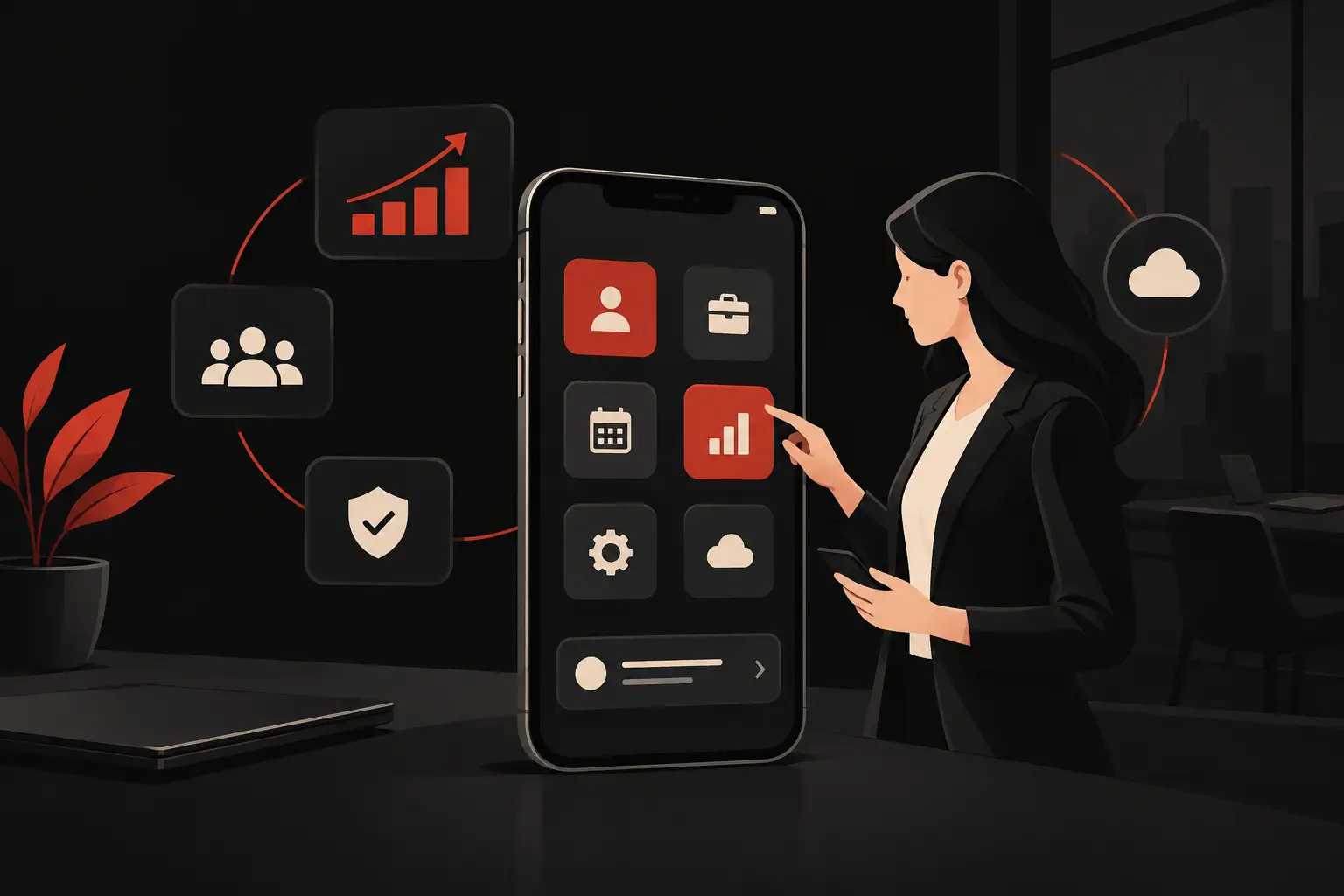
The same applies to businesses with a lot of field work. If technicians, sales agents or operators need to receive assignments, complete checklists, attach photos, collect signatures, update service calls and generate documents on mobile devices, the operational process deserves an interface designed for the actual use context, not a screen adapted later on.
The value of vertical software becomes clear when it reduces the number of exceptions. If the team has to leave the management system every day to use spreadsheets, chats, email and paper forms, the system is not governing operations. It is only recording part of what happens.
Don’t choose by features: choose by critical workflows
A feature list is useful, but rarely settles a decision. Two platforms may both claim to manage customers, orders, inventory and reports. What differs is the number of steps required to complete an operation, the quality of the data produced and how easily the process can evolve.
Before evaluating an ERP or vertical solution, it is useful to map the workflows that directly affect revenue, costs and customer experience. Theoretical diagrams are not needed; real examples are. Where does an order start? Who checks it? When is availability verified? Where are exceptions recorded? How is margin calculated? When does the customer receive an update?
This analysis often brings to light problems more important than the software choice: duplicate data, unclear responsibilities, informal approvals, information stored in one person’s email. Digitizing a confusing process does not improve it. It simply makes it faster at producing confusion.
To guide the choice, four questions are particularly practical:
- Is the process that creates the most value standard in our industry, or does it contain proprietary rules?
- How many people enter or copy the same data into different tools?
- Which decisions are we unable to make because data arrives late or is incomplete?
- Which exceptions currently require phone calls, email, external files or manual checks?
If the answers mainly concern accounting, warehousing and general coordination, a well-configured ERP may be the right hub. If they concern industry-specific operations, field activities, product configurations, projects or distinctive workflows, vertical software may deliver a faster return.
The false dilemma: ERP and vertical software can coexist
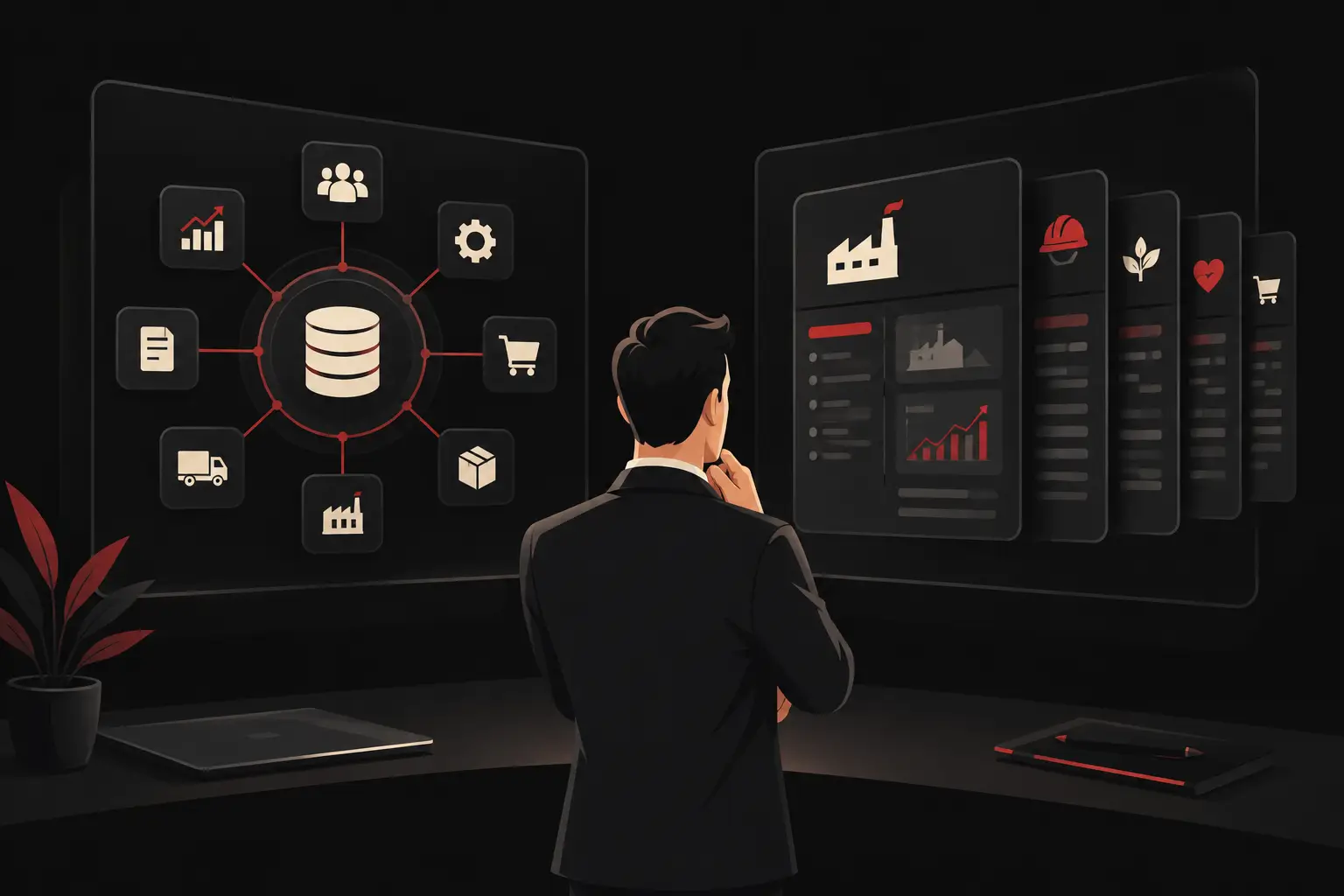
In many mature companies, the choice is not either-or. The ERP remains the central system for administrative, financial and logistics data, while vertical management software handles the highly complex process. The two platforms exchange data through integrations designed according to clear rules.
A technical services company is a concrete example. The ERP can manage invoicing, records, purchasing and accounting. The vertical system can coordinate service scheduling, technicians’ skills, spare parts, geolocation, signed service reports and scheduled maintenance. The goal is not to create two separate databases, but to assign each system a specific role.
This architecture requires care. Integrating software without defining the authoritative source for each data item creates inconsistencies. The customer must have a primary record, the order a reliable sequence, and updates a verifiable history. Without this governance, integration becomes another point of fragility.
Costs: comparing prices is not enough
A standard ERP may seem more affordable thanks to predictable licenses and shorter initial timelines. However, the real cost includes configuration, training, data migration, process adaptation, support and custom development. If customizations keep increasing, the initial advantage quickly diminishes.
Vertical or custom management software, on the other hand, requires a more substantial project investment upfront. Its value depends on the frequency and cost of the problem it solves. Automating a task performed twice a month has a different impact from eliminating ten minutes of manual work from every order, service call or case handled by the company.
To evaluate ROI, you need to estimate hours saved, errors avoided, fulfilment times, margin recovered, production capacity freed up and service quality. A system that reduces support requests, speeds up quoting or enables better resource planning can deliver results far more significant than simply saving on the licence.
How to make a decision without slowing the business down
The choice should start with a clearly defined scope, not a demo. Define the processes to improve, the users involved, the expected outputs and the metrics for measuring progress. For example: reduce order-entry time by 30%, cut non-conformities, gain daily visibility into project margins or shorten customer response times.
Then separate what is essential from what is desirable. A project that attempts to digitise every department at the same time risks slowing adoption and results. It is better to start with the process flow that has the greatest economic impact and build an integrated foundation for the next stages.
The analysis phase must involve the people who use the tools every day. Management and team leads set the objectives, but operators, sales staff, technicians and administrative staff know the exceptions that can derail a process that looks sound on paper. Ignoring them leads to software that is formally complete but bypassed in practice.
The rollout also deserves a strategy. Migrating clean data, testing real-world scenarios, training by role and monitoring indicators during the first few weeks is more effective than an abrupt launch. The platform should be treated as an operational asset to improve over time, not as a purchase completed upon delivery.
Graffico approaches these projects by starting with the workflows that hinder growth and control, turning them into measurable, integrated digital tools that reflect how the company actually works.
The best choice is neither the best-known ERP nor the industry-specific system with the most options. It is the system that makes decisions visible, eliminates manual steps and enables your organisation to grow without multiplying complexity and headcount.
Ready to bring your ideas to life?
Request a free, no-obligation consultation. Let's talk about your project.
Request a consultation