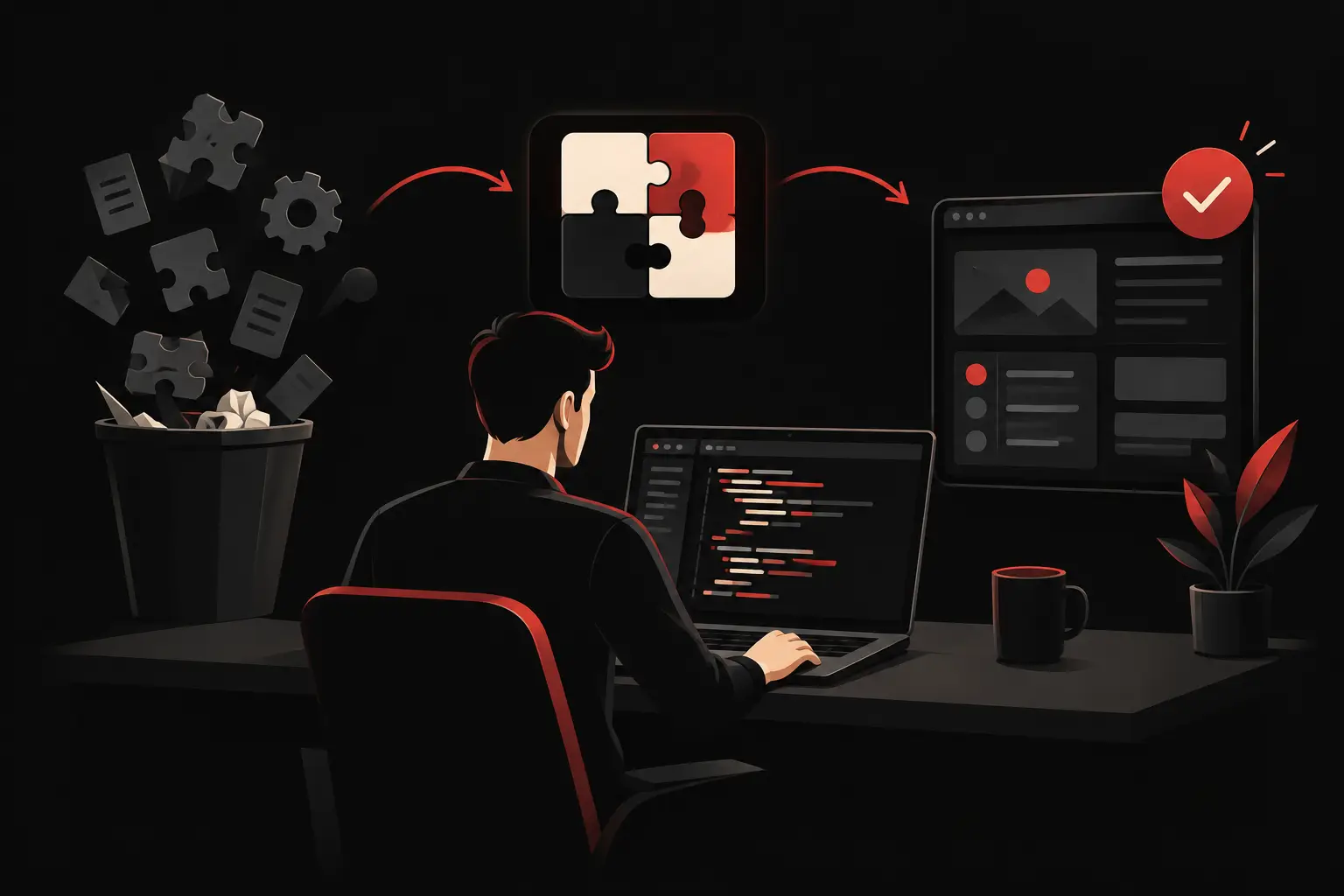
Custom software development, less waste
Software development transforms fragmented processes into measurable tools, reduces errors and operating times, and supports tangible business growth.
An order arrives by email, the data is copied into a spreadsheet, the sales representative updates the CRM at the end of the day, and administration discovers an anomaly when it is already too late. This is not a problem of people’s commitment: it is the hidden cost of processes built up layer by layer. software development is needed when separate tools, manual steps, and incomplete information begin to slow down sales, operations, and customer service.
For many SMEs, going digital does not mean adding yet another subscription platform. It means designing a system that reflects how the company really works, removes bottlenecks, and makes data usable for decision-making. The result is not software for its own sake, but an operational infrastructure that saves time, reduces errors, and supports growth without weighing down the internal structure.
Software development: when is it really needed?
Custom software is not the automatic answer to every need. If a process is simple, standard, and not a point of differentiation, an existing solution may be quicker and less expensive to adopt. A standard business management system, for example, may cover common administrative functions or established accounting needs effectively.
The limitation becomes apparent when the company is forced to change its way of working to adapt to the tool, or when it makes up for shortcomings with Excel files, emails, chats, and manual checks. In these cases, the initial savings turn into lost hours, duplicate data, and decisions made with partial information.
custom development is recommended when a process has a direct impact on margins, service quality, or sales velocity. It can involve managing orders with complex rules, a CRM built around the actual sales cycle, a supplier portal, a booking system, a KPI dashboard, or theintegration of software that currently does not communicate with each other.
The right question is not how much an application costs. It is how much it costs each month to maintain an inefficient workflow. If five people spend part of their day transferring data, checking discrepancies, or chasing approvals, the problem is already measurable. And therefore improvable.
From symptom to measurable process
The starting point should not be a list of features. Asking for an app to manage orders or a customized CRM is understandable, but risks leading to an incomplete solution if the operational workflow is not analyzed first.
An effective project starts with questions that affect results: where does work get stuck? Which information is entered more than once? Which tasks depend on people’s memory? How much time passes between a customer’s request and a useful response? What data is missing to understand whether a department is performing well?
This phase turns a general need into concrete requirements. It is not enough to say that the system should be intuitive. You need to define who will use it, what actions they need to perform, what permissions are required, what data feeds the process, and which indicators should be visible to management.
Consider a company that manages complex quotes. The real problem may not be creating the quote, but the lack of shared rules for discounts, configurations, revisions, and approvals. Well-designed software can guide the user, apply commercial constraints, notify managers, and create a reliable history. The benefit is not just speed: it is greater consistency in the offering and more precise control over margins.
The stages that make the project sustainable
Valuable software development is not just programming. Coding without a clear scope can quickly produce the wrong product. A serious project process requires four connected steps.
- Operational analysis. Roles, existing tools, exceptions, data sources, and measurable objectives are mapped. This is when hidden costs emerge: duplicate entries, delays, recurring errors, and dependencies on specific individuals.
- Experience and architecture design. The interface and logic must work together. A powerful but hard-to-use business management system will be bypassed by users; an elegant screen disconnected from the data solves nothing. Workflows, priorities, permissions, integrations, and information structures are defined before building.
- Incremental development. Releasing in modules makes it possible to validate the most critical functions, gather feedback, and adjust course without waiting months. Not every project requires the same sequence: for some, it is crucial to start with the operational core; for others, with data centralization or customer-care automation.
- Monitoring and improvement. Release does not bring the work to a close. Training, adoption measurement, change management, and maintenance are needed. Software must continue to support the company as volumes, people, business rules, and sales channels change.
This approach avoids two common mistakes: building too many features before getting confirmation from users, and merely digitizing an inefficient process without rethinking it. Turning a paper procedure into an online form can be useful, but it is not always innovation. Sometimes the real value lies in eliminating a step, automating a check, or making information available at the right moment.
Integrations, automation, and AI: where returns are generated
Isolated software rarely reaches its full potential. Value grows when it connects the tools already in place: e-commerce, ERP, CRM, payment platforms, logistics, marketing, and support. The goal is not to integrate for technical reasons, but to ensure reliable data flows without repetitive intervention.
An order placed online can update availability, generate documents, open a work order, and notify the customer of the delivery status. A lead can be assigned by territory or type, with automatic follow-ups and immediate visibility into stalled opportunities. A dashboard can bring together sales, order progress, and margins, so management does not have to reconstruct the situation from different sources every week.
Artificial intelligence should be assessed by the same criteria. An AI agent can classify requests, extract data from documents, suggest customer-care responses, or flag anomalies in workflows. However, it cannot replace disorganized data and confused processes. Rules, sources, and responsibilities must be defined first; then automation can increase speed and accuracy.
Premium design means less operational friction
In B2B software, design is often considered a secondary element. That is a costly mistake. Every unnecessary field, ambiguous status, and overloaded screen increases the time needed to complete a task and the likelihood of making errors.
A well-designed interface takes users to the essential data, makes the next actions clear, and immediately communicates what requires attention. This is particularly relevant for tools used every day by salespeople, operators, technicians, and administrative staff. If adoption is low, even the best system remains an underused investment.
Design and performance should therefore be assessed together: loading times, workflow clarity, mobile use, data accessibility, and visual consistency directly affect productivity. For Graffico, technology and design are not two separate layers of a project: they are components of the same operational lever.
How to measure value after launch
The return on a project should not be measured solely by the number of features delivered. The indicators depend on the initial objective: average order processing time, error reduction, lead response speed, percentage of tasks automated, decrease in repetitive tickets, or forecast accuracy.
It is useful to establish a baseline before release. Without a comparison, improvement remains a perception; with clear data, it becomes a defensible investment decision. Not all benefits will be immediate: some arrive when the team adopts the new workflow and historical data begin to produce reliable insights.
The best choice is to start with the process that creates the most friction or has the greatest impact on revenue and margins. When an operational problem is made visible, measurable, and automatable, software ceases to be a technical cost item and becomes a concrete foundation for growing with greater control.
Ready to bring your ideas to life?
Request a free, no-obligation consultation. Let's talk about your project.
Request a consultation