Custom ecommerce vs. Shopify: which is the better choice?
Custom ecommerce vs. Shopify: compare costs, integrations, and scalability to choose a platform that reduces inefficiencies and supports business growth.
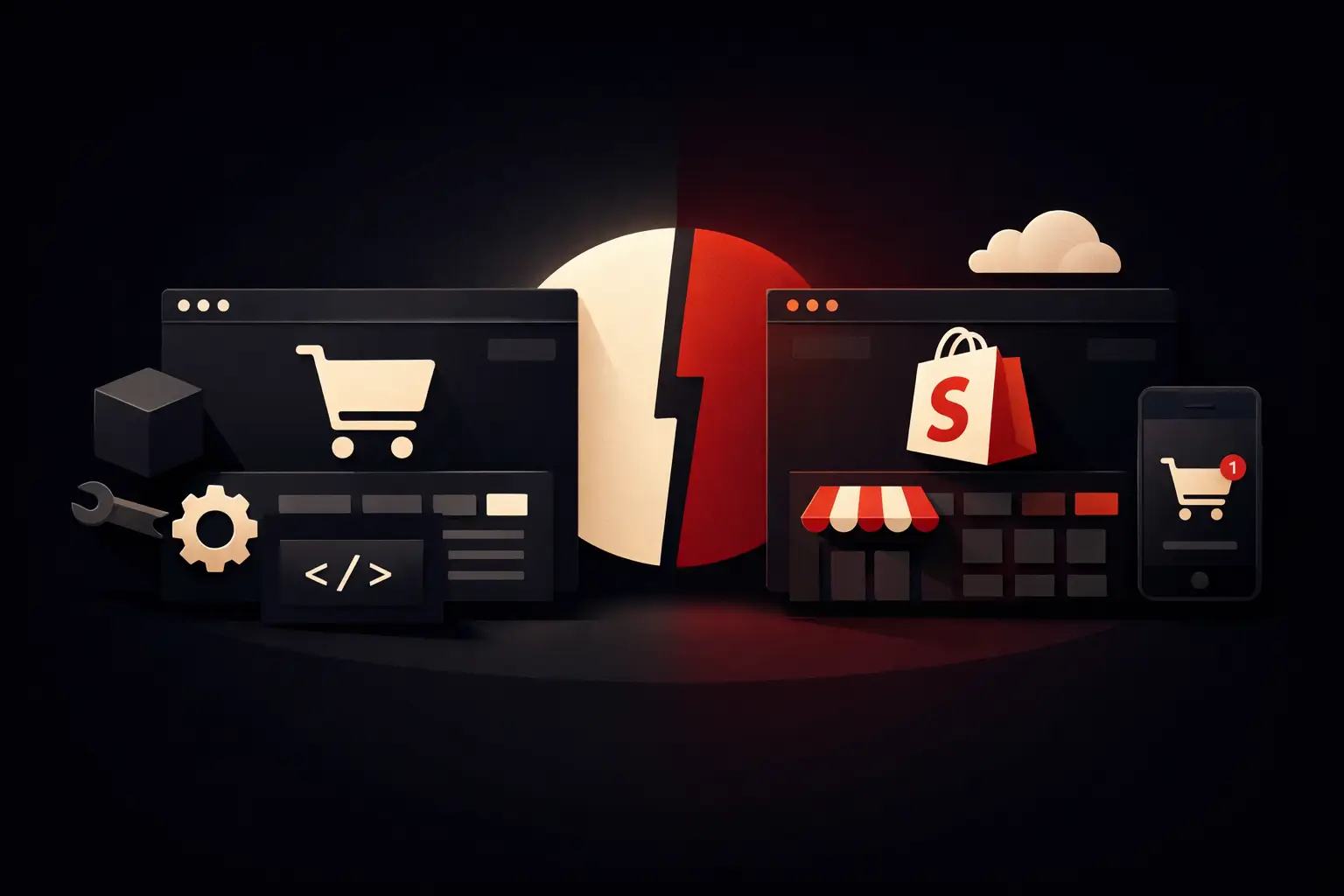
An ecommerce store that receives lots of orders but requires hours of manual data entry, inventory checks, and reconciliation between tools is not really scaling. When choosing custom ecommerce vs. Shopify, the question is not which platform is best overall. The right question is which solution supports your operating model without turning growth into a hidden cost.
Shopify makes it quick to get online with a mature ecosystem. A custom ecommerce store, on the other hand, can become a proprietary asset built around specific processes, data, and commercial logic. Both are valid approaches, but they are designed for different priorities.
Custom ecommerce vs. Shopify: the real difference
Shopify is a SaaS platform: the infrastructure, security updates, checkout, and many standard features are already available. The benefits are immediate: shorter launch times, more predictable upfront costs, and less technical complexity for businesses selling products with a relatively straightforward catalog, logistics setup, and commercial rules.
A custom ecommerce store does not start with a catalog of predefined features. It starts with an analysis of the business. It can be developed using technologies and architectures selected to meet requirements for integrations, order flows, price lists, user roles, configurators, B2B management, and automation goals.
So the difference is not simply “simple” versus “complex.” Shopify standardizes to make execution faster. Custom development removes compromises when the business process is already more sophisticated than the standard offering.
Shopify: speed, standardization, control over upfront costs
For a D2C brand looking to validate a product, launch a new line, or start selling online, Shopify offers a highly effective foundation. Its back office is intuitive, the catalog is quick to update, and themes, apps, and configurations can meet many common needs.
This approach works well when checkout follows conventional rules, prices are the same for everyone or differ only slightly, orders are handled without complex internal steps, and data does not need to feed into specialized processes. Speed also delivers tangible value for seasonal campaigns, temporary digital stores, or markets you want to test.
The limitations become clear when a business tries to use lots of apps to compensate for needs the platform was not designed to meet. One app for price lists, one for promotions, one to connect to the business management system, one for invoicing, and one for shipping. At first, this seems efficient. Over time, it can lead to recurring subscription fees, duplicated data, dependencies on third-party vendors, and difficulty identifying the source of an error.
Custom: process control, not just front-end control
Custom ecommerce is a good fit when selling online involves rules with a significant operational impact: price lists reserved for customers or agents, quotes that can be converted into orders, real-time availability across multiple warehouses, internal approvals, recurring orders, configurable products, or commercial terms based on geographic area.
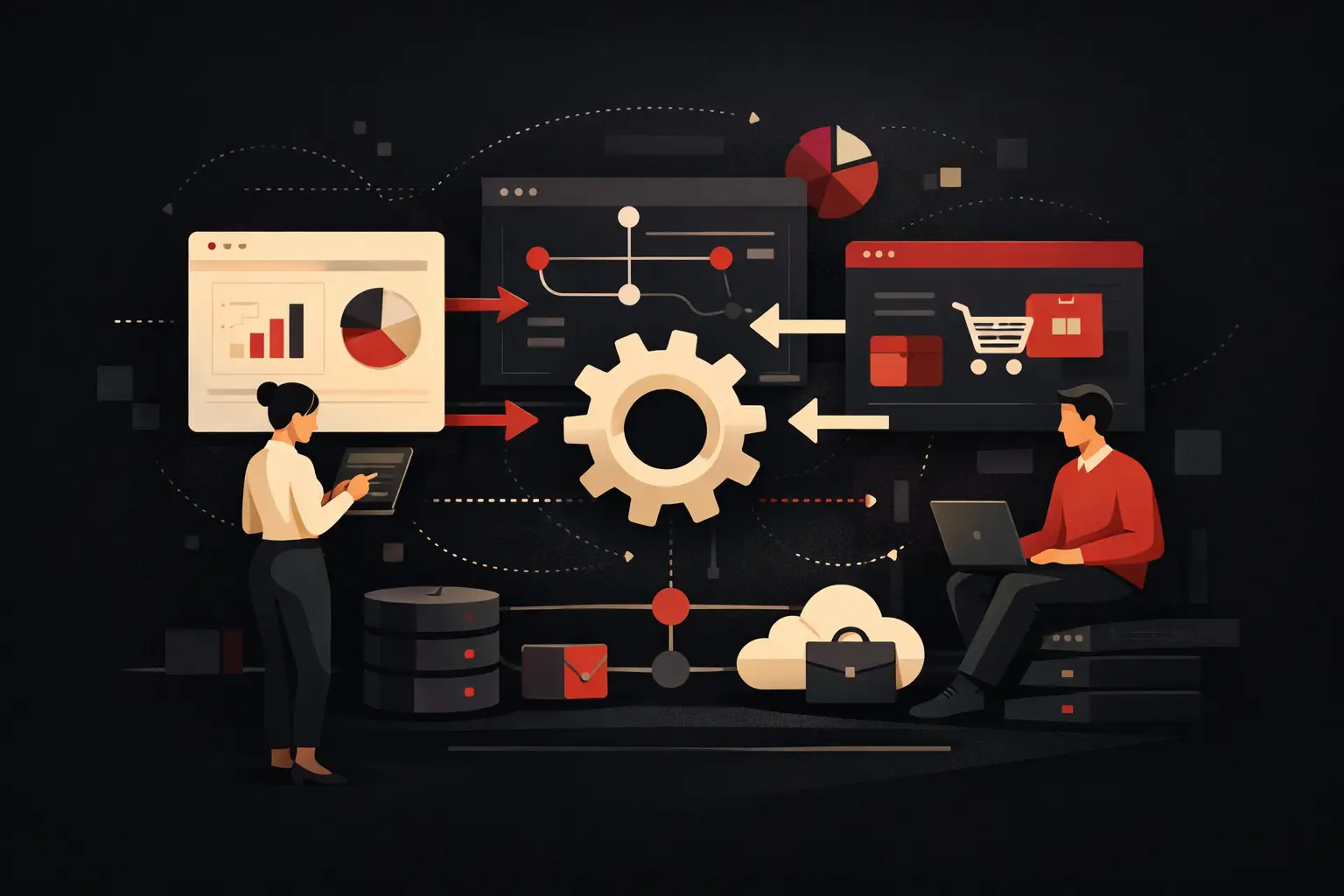
In these cases, the platform is not just a storefront with a cart. It is an access point to a business system. It can communicate with ERP, CRM, PIM, WMS, production software, supplier portals, and KPI dashboards. The goal is to have information flow once, to the right place, instead of copying it between departments and tools.
Design also plays an operational role. A premium interface improves brand perception, but, more importantly, it reduces friction in the buying journey, speeds up reordering, and makes even technical or very extensive catalogs easier to navigate. For a B2B business, for example, quickly finding the right product and viewing account-specific terms can matter more than a spectacular homepage.
Costs: look at TCO, not just the quote
With Shopify, the initial cost tends to be lower. However, on top of the platform subscription, theme, configuration, and development, you also need to factor in apps, transaction fees, ongoing development and maintenance, possible higher-tier plans, and integration costs. That is not inherently a problem: it is the price of speed and an ecosystem. But you should calculate it over a period of at least three years.
Custom development requires a larger upfront investment because it covers analysis, UX, development, testing, integrations, and training. It may be less cost-effective for a small project with uncertain margins or requirements that are still evolving. Building a proprietary solution too early means tying up resources before you have validated the market.
On the other hand, a standard system that forces five people to carry out manual checks every day has a cost that often goes unnoticed. Add up administrative time, order errors, fulfillment delays, customer support, and lost sales opportunities. The right comparison is not between a monthly subscription and a software project: it is between the current total cost of operation and the value created by a more efficient process.
Integrations and data: the factor that changes the decision
Many ecommerce businesses fail not because of a lack of traffic, but because their data management is disorganized. Out-of-date prices, inconsistent stock levels, duplicate customers, and orders that need to be re-entered make every marketing investment fragile. If each additional sale creates another manual task, growth increases operational pressure instead of reducing it.
Shopify offers APIs and integrations for many use cases. It can be an excellent choice for common workflows. However, you need to check the depth of the connection carefully: what data passes through, how often, which system is the source of truth, and what happens if something goes wrong. A connector does not automatically guarantee a reliable process.
A custom project lets you define the architecture around the source of the data. The business management system can remain the source of truth for inventory and invoices, the CRM for customer relationships, and ecommerce for the shopping experience and orders. Automation and dashboards connect these layers without creating silos. This approach is particularly relevant for businesses with multiple channels, sales networks, professional customers, or catalogs that are constantly being updated.
When Shopify is the more rational choice
Shopify is often the right answer if your goal is to get to market quickly, your catalog is manageable, sales are primarily B2C, and the order-to-shipping process has no significant exceptions. It is also a good fit when your internal team needs to manage content and promotions independently, without relying on a developer every time.
Shopify also makes sense for an initial validation phase. If you do not yet know which products convert, which markets respond, or which offer model will gain traction, a lightweight stack lets you collect real-world data without overengineering.
The key is discipline: configure the data model properly, avoid redundant apps, document integrations, and define from the outset which metrics to track. Speed should not mean cutting corners.
When it makes sense to invest in custom ecommerce
Custom development becomes strategic when the platform needs to do much more than process a payment. For example, when a B2B customer needs to access dedicated catalogs, negotiate terms, reorder from order history, download documents, and interact with their account manager. Or when availability depends on production, configuration, technical variants, or complex delivery rules.
It is also the stronger choice when integrations are not optional extras but are central to profitability. If an order needs to update inventory, generate documents, notify the right department, feed a dashboard, and trigger customer communications, automation needs to be designed as part of the product.
Another warning sign is reliance on workarounds. If the team exports files every morning, corrects data by hand, or uses spreadsheets to make online sales work, you do not just have a platform problem. You have a process that needs to be redesigned.
The best choice can be a gradual one
It is not always necessary to choose between Shopify alone and fully proprietary development. In some situations, the most effective solution is a hybrid approach: Shopify for the commercial front end, with a custom layer for integrations, B2B logic, automation, or private portals. In other cases, you can start with a standard MVP and plan its evolution after collecting enough data.
The sequence matters. First, map the workflows, bottlenecks, existing systems, and KPIs. Only then decide what to standardize, integrate, and build. Graffico approaches ecommerce projects from this perspective: turning operational complexity into a measurable system, not adding technology for its own sake.
The right platform is the one that makes selling, fulfilling orders, and making decisions easier, even as order volumes increase. Before evaluating a demo or a quote, measure where your team is losing time today: that is where the choice can deliver the most tangible return.
Ready to bring your ideas to life?
Request a free, no-obligation consultation. Let's talk about your project.
Request a consultation