AI in Wealth Management: Design That Turns Data into Human Relationships
The financial sector is experiencing a silent crisis: advisers spend more time filling out forms than talking to clients. Faybl steps in with an identity that promises not just speed, but “time for what matters.” Here’s how design turns an algorithm into a trusted partner.
In the world of financial advice, time is both the most precious and the most wasted resource. Faybl doesn’t present itself as yet another “fast” tool, but as the bridge that lets advisers be human again. Its visual identity is a lesson in psychology applied to business.
The problem with financial services today is paradoxical. Advisers are buried under compliance reports, CRM updates, and technical preparations. The more technology advances, the more they seem enslaved to digital bureaucracy instead of cultivating relationships with clients.
The studio Fubo Studio understood that selling AI in this sector doesn’t call for signals of “cold efficiency.” It calls for warmth. The challenge was: how do you make an AI agent feel like an extension of human trust rather than a robotic replacement?
The chaos of “Cold Fintech”: when precision drives clients away
Many fintech startups fail at branding because they choose a purely technical aesthetic: neon colors, ultra-thin fonts, and futuristic animations. This creates a strategic mess in wealth management:
Lack of empathy: A client entrusting you with their wealth wants to feel heard, not processed by a machine. If the brand shouts “computing speed,” the client perceives “lack of care.”
Visual complexity: Using data-heavy graphics makes the tool seem difficult to use, discouraging advisers who are less inclined toward technology.
Trust crisis: In 2026, AI is viewed with suspicion. If the brand feels like an impenetrable “black box,” trust collapses before it even has a chance to take hold.
The cost analysis: what does it cost you to be perceived as “just software”?
If your service business is seen only as a technical tool, you’ll be treated as a replaceable “utility.”
Here’s the financial blow of bad branding:
Price wars: If you don’t communicate “human connection” and “relationship value,” your only advantage will be the lowest price. Trust-based companies, on the other hand, can afford much higher margins.
High churn rate (customer attrition): It’s easy to cancel a subscription to cold software. It’s much harder to leave a partner who helps you “free up time for what matters.”
Low product adoption: If advisers see AI as a threat to their professionalism (because the brand feels too “autonomous”), they’ll sabotage the tool’s use internally.
The solution: the node system and the palette of trust
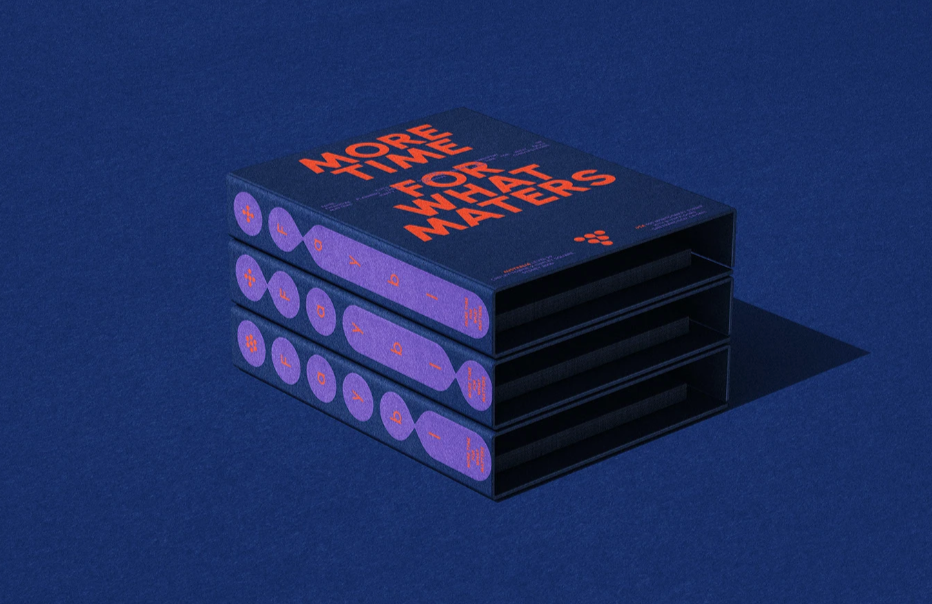
Fubo Studio built Faybl’s identity around one key concept: interconnected nodes.
The Cluster Symbol: Not a static logo, but a series of points (data, contacts, intelligence) that come together to form an ecosystem. Visually, this communicates that AI doesn’t act alone, but is part of a pre-existing network of trust.
Dual-logic typography: Bold, minimalist headlines to convey “enterprise” confidence; widely spaced text to communicate accessibility and breathing room.
Warmth vs. Precision: The color palette blends the precision typical of finance with warm, emotional tones. It’s design that says: “We’re as precise as a computer, but we understand how you feel.”
The Graffico Take 🔴
At Graffico we believe the best technology is the kind that “disappears” to make room for human outcomes.
The lesson for your business:
Use design to balance your weak points: If your product is technological and potentially cold, use your brand to add warmth.
Show the value, not the process: Don’t show “how” the AI calculates; show “what” the client gets (time, clarity, relationships).
Create a living system: A modern brand isn’t a fixed stamp, but a language that adapts to every touchpoint, just like Faybl’s nodes.
Design isn’t there to sell a product; it’s there to sell the best version of the person who will use it.
Ready to bring your ideas to life?
Request a free, no-obligation consultation. Let's talk about your project.
Request a consultation