AI 2025: The honeymoon is over. Welcome to the trillion-dollar "Vibe Check".
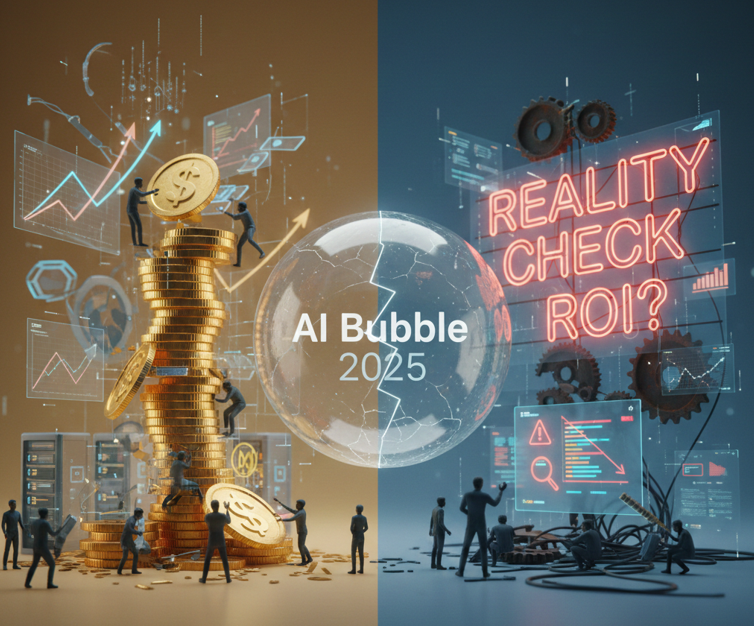
2025 was the year artificial intelligence had to face reality. Between $40 billion funding rounds and fears of a bubble ready to burst, the market is shifting gears: promising the future is no longer enough; businesses have to prove they can hold up.
If the first half of 2025 was a party fueled by blank checks, the second half brought the bill. And it is a hefty one. The AI sector experienced a year of extreme contrasts: on one hand, an unprecedented torrent of capital; on the other, the nagging suspicion that return on investment (ROI) is still a distant mirage. Welcome to the year of the "Vibe Check".
The numbers of the frenzy (and hope)
To understand the scale of the phenomenon, just look at the numbers. 2025 redefined the concept of a "startup":
OpenAI closed a $40 billion round led by SoftBank, 40 billion dollars, bringing its valuation to $300 billion. And it isn't stopping: it is targeting an IPO worth 1,000 billion next year.
Anthropic didn't sit on the sidelines, raising 16.5 billion (although its CEO admitted he wasn't enthusiastic about accepting funds from authoritarian Gulf states).
Newborn startups like Thinking Machine Labs (founded by former OpenAI CTO Mira Murati) secured a $2 billion seed round without having shipped a single product.
The circular economy of chips
But where does all this money go? Here's where things get thorny. We're witnessing what many analysts call the "circular economy". The capital raised by AI labs almost immediately flows back into the pockets of infrastructure providers. OpenAI receives billions, which it then spends on Nvidia chips and Microsoft or Oracle servers. The risk? That growth is fueled by cross-investments rather than real customers paying for the service. It's no coincidence that Blue Owl Capital just pulled out of a $10 billion deal with Oracle, a sign that major financiers are starting to get nervous.
The wall of incremental progress
Beyond money, there's a problem of "magic." If the leap from GPT-3 to GPT-4 left us amazed, the 2025 releases (such as GPT-5) were seen as incremental improvements, not revolutions. Meanwhile, China shook things up with DeepSeek R1: a model capable of competing with American giants at a fraction of the cost. The message is clear: scaling by spending billions is no longer the only way, and that terrifies those who have bet everything on brute computational force.
Graffico's Output 🔴
Why is this "vibe check" a vital lesson for business owners? Because it marks the shift from an era ofblind enthusiasm to one of operational diligence.
Companies can no longer simply "implement AI" because it's trendy. 2025 teaches us that:
Infrastructure costs are the new debt: Running proprietary models costs a fortune in energy and servers.
Safety isn't optional: Cases of "AI psychosis" and dangerous hallucinations are prompting strict regulations (such as California's SB 243).
Value lies in the moat, not the model: The winner isn't the one with the most powerful model, but the one who controls the customer. That's why OpenAI is launching its browser (Atlas), and Perplexity is paying Snap to be inside Snapchat.
The future of AI is no longer a question of "if" it will work, but of "how much" it will cost us to make it work without bursting the bubble or destroying users' trust.
Ready to bring your ideas to life?
Request a free, no-obligation consultation. Let's talk about your project.
Request a consultation