Interactive 3D Web Experiences That Convert
Interactive 3D web experiences improve engagement, brand perception, and conversions. When do they really work, and how should you design them?
You don’t need a wow effect for its own sake to stand out online. You need an interaction that helps people understand a product faster, showcases a complex service, and reduces friction along the conversion journey. This is where interactive 3D web experiences stop being an aesthetic choice and become a business tool.
For many companies, the problem isn’t “having a beautiful website.” It’s explaining what they sell clearly, conveying perceived quality, increasing attention, and guiding users toward a clear action. In some contexts, web-based 3D can do all this better than a static page. In others, it adds complexity, slows things down, and distracts. The difference lies in the design.
What interactive 3D web experiences really are
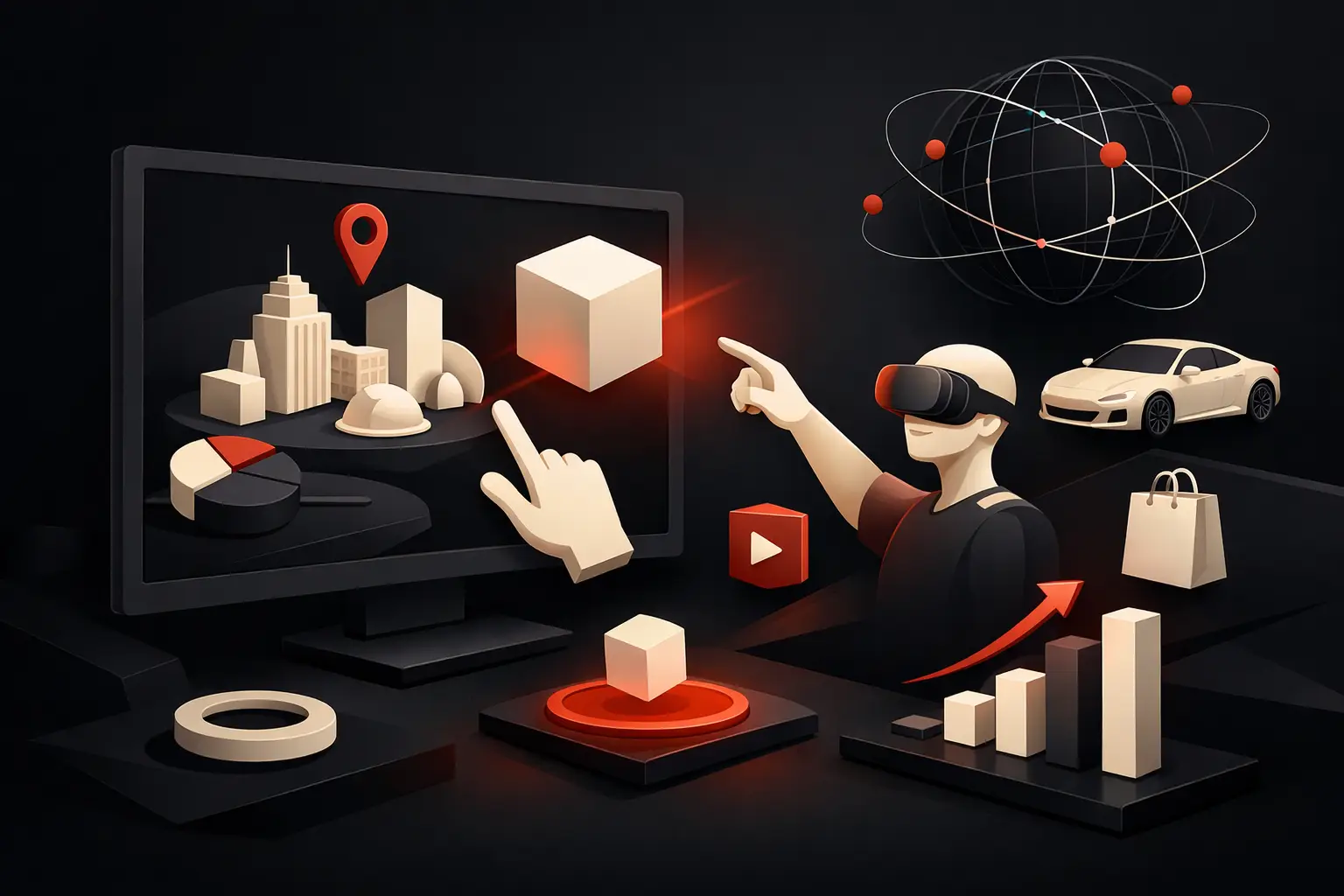
When people talk about online 3D, they often think of a spectacular homepage or an object rotating on screen. In reality, interactive 3D web experiences are environments, configurators, product visualizations, digital showrooms, simulations, or immersive interfaces that respond to user actions and serve a specific purpose.
The key element isn’t the three-dimensional model. It’s the interaction. If users can explore a machine, change materials, view variations, understand internal components, or simulate a final result, 3D becomes a catalyst for understanding. This is particularly useful in sectors where the value of an offering is hard to communicate through 2D images alone or generic copy.
For a manufacturing company, this could mean showcasing a complex plant without bringing a prospect on site. For a premium brand, it could immediately raise perceived quality. For an e-commerce business, it could reduce uncertainty and returns. For a B2B company with a long sales cycle, it can become a sales tool that takes on part of the sales team’s work upfront.
When 3D on the web creates real value
The point isn’t to ask whether 3D is modern. The point is to understand whether it delivers a measurable advantage at a specific stage of the funnel.
Interactive 3D web experiences work well when a product is technically complex, highly visual, or high-value. If you sell custom furniture, industrial machinery, technology systems, finishes, medical devices, real estate, or customizable products, 3D can narrow the gap between interest and decision.
It also works when traditional presentations limit understanding. A static rendering shows a result. An interactive environment explains how that result changes based on real variables. This shifts the conversation from an abstract promise to a more tangible perception of value.
There’s another often overlooked factor: positioning. A well-crafted experience communicates expertise, precision, and a high level of innovation even before the first sales conversation. It doesn’t replace the quality of the offering, but it makes it more credible.
When interactive 3D web experiences aren’t worth using
Not every company needs 3D, and not every project benefits from it. If your goal is to collect leads quickly through a very direct landing page, adding an interactive layer can slow things down and increase distraction. If the product is simple, low-priced, and bought on impulse, clarity often beats immersion.
The technical context matters too. Interactive 3D web experiences require serious optimization for performance, devices, and browsers. A slow experience on mobile doesn’t communicate innovation. It creates friction. And friction costs conversions.
The same rule applies to project governance. Without a strategy for content, tracking, UX, and maintenance, 3D risks becoming an expensive showcase isolated from the rest of the digital ecosystem.
The real point: 3D must serve an operational goal
An effective project always starts with a simple question: what should the website do better after 3D is introduced?
Useful answers are concrete. Increasing time on site makes sense if that time leads to a demo request. Improving engagement matters if it helps users configure a product and leave their details. Reducing doubts during the pre-sales stage is valuable if it eases the workload of sales or support teams.
That’s why design shouldn’t start with the visual effect, but with the process. Where do users get stuck? What information do they not understand? Which elements are currently difficult to sell or explain? At what point are opportunities lost?
When 3D addresses these issues, it stops being an add-on and becomes part of the digital sales infrastructure.
How to design interactive 3D web experiences that perform
The first decision is about the level of complexity. You don’t always need a fully immersive environment. In many cases, a focused interaction works better: a product configurator, an exploded view of components, a guided scene with informational hotspots, or a navigable demo linked to clear CTAs.
The second decision concerns technical weight. Models, textures, lighting, and animations must be optimized for the web, not simply exported from pipelines designed for offline rendering. The trade-off between visual quality and performance isn’t a minor detail. It’s a strategic decision that affects usability and conversion.
The third concerns the role of the interface. A 3D environment without guidance can be fascinating but not very useful. Users need to understand right away where to look, what to do, and why the interaction benefits them. Microinteractions, supporting text, visual hierarchy, and pathways to forms, quotes, or contact options are all part of the same experience.
Finally, there’s integration. A mature project connects 3D to the CRM, event tracking, lead generation systems, or product catalog. If a user configures an item, that choice can become sales data. If they explore certain areas, that behavior can inform segmentation or follow-up.
This is where an approach like Graffico’s makes sense for companies that aren’t looking for an isolated creative asset, but for a tool capable of generating operational impact.
UX, performance, and accessibility: three constraints that determine the outcome
There’s a common temptation with web-based 3D: to prioritize the scene and leave everything else in the background. That’s a mistake. UX, performance, and accessibility aren’t creative limitations. They determine whether the experience will actually be used.
UX should reduce cognitive load. If users have to figure out how to navigate on their own, you’re already losing effectiveness. Controls should be intuitive, the journey easy to follow, and interactions reversible. Every extra step needs to be justified.
Performance is even more critical. 3D can feel premium only when it responds smoothly. Long loading times, stuttering, and incompatibility undermine trust. In business, this affects not only the user experience but also the company’s overall perception.
Accessibility is often overlooked. Interactive content must provide informational alternatives, support for different devices, and an experience people can understand even when some features aren’t available. That doesn’t mean compromising the project. It means making it more robust.
KPIs to track: how to measure returns
If a project is well conceived, metrics go beyond views. Interactive 3D web experiences should be evaluated against the goal they were created to achieve.
If they support sales, it makes sense to track key interactions, CTA clicks, demo requests, quotes started, and lead quality. If they support e-commerce, useful metrics include meaningful time spent, add-to-cart rate, fewer returns, or a higher average order value. If they support B2B pre-sales, you can monitor qualification times, the frequency of repeated questions, and the speed of the sales cycle.
The most useful data point is never an isolated metric. It’s the relationship between engagement and results. A spectacular experience that doesn’t move any sales KPI is a cost. A more understated experience that improves conversion, lead quality, or product understanding is a sensible investment.
A decision to make based on criteria, not trends
The market will increasingly reward companies that can explain, showcase, and sell better online. Interactive 3D can be a powerful lever, but only when it’s part of a broader strategy built around UX, performance, data, and processes.
So the right question isn’t whether your website should look more innovative. It’s whether it can become more useful, persuasive, and measurable. When interactive 3D web experiences are built with this in mind, they stop being a special effect and start working for the business.
Before investing, ask yourself a very practical question: which part of your sales process or digital presentation would become more effective if customers could understand, try, or configure something instead of simply looking at it?
Ready to bring your ideas to life?
Request a free, no-obligation consultation. Let's talk about your project.
Request a consultation