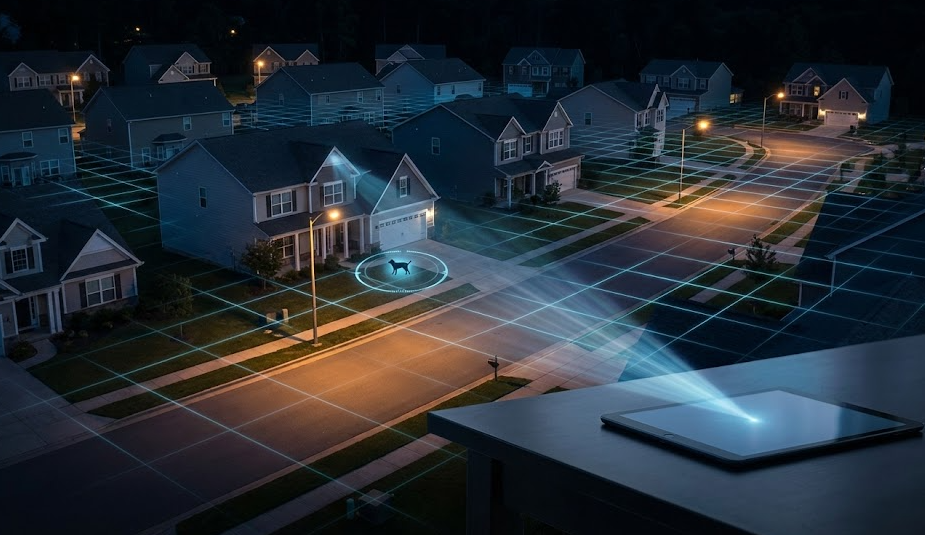
Beyond selling products: how Amazon is becoming the owner of neighborhood security
Ring (Amazon) is opening its camera network to everyone, including people who don’t own its product. It’s not just a way to find lost pets; it’s a masterclass in how to dominate a market by turning your customers into public infrastructure.
Selling a camera is a one-time deal. Building a network of digital eyes covering entire cities is a strategy for making the competition irrelevant. The evolution of Ring’s “Search Party” feature teaches us that the real value isn’t in the object, but in the network it creates.
There’s a powerful business strategy called the “network effect”: the more people use a system, the more valuable that system becomes to everyone else. Amazon, through its Ring brand, has just taken this concept to the next level.
The “Search Party” feature, which uses artificial intelligence to locate lost dogs in video footage, is no longer reserved only for people who have bought one of their cameras. Now it’s open to anyone who downloads the app. It’s a brilliant move: they’re no longer just selling “hardware,” but starting to offer “territorial utility.”
The chaos of traditional searches: when inefficiency costs time and money
Losing a pet or experiencing a theft creates disorder that goes beyond the emotional impact. It wastes time and resources and undermines coordination:
Fragmented efforts: Flyers, social media posts no one sees, and hours spent searching in vain. The inefficiency is total.
Technological barriers: People have cameras, but the data is locked away in private “islands.” If your dog walks past a neighbor’s house, that information is lost because there’s no quick, secure way to share it.
Emergency management costs: Animal shelters and rescues are overwhelmed because they can’t track down owners quickly. Every day an animal spends in a facility costs the community money.
The strategic analysis: why give a feature to someone who isn’t a customer?
A distracted entrepreneur might ask: “Why does Amazon let people use this technology if they haven’t paid for the camera?” The answer is purely economic.
Here’s the company’s return on investment:
Massive increase in data: The more people use the app, the denser the network becomes. Even people without a Ring camera contribute by reporting lost pets, making the network more active and more essential.
Market standardization: If everyone uses Ring’s app for neighborhood emergencies, the brand becomes the standard. Anyone who needs to buy a new camera in the future will choose Ring to be “inside” the network that matters.
Infrastructure as a service: By investing one million dollars to equip 4,000 animal shelters, Amazon is literally fencing in the market. It’s building a system where every “outflow” (the lost animal) and every “inflow” (the shelter) goes through its software.
The solution: artificial intelligence as a neighborhood coordinator
The system works in a simple and ruthless way. When a user reports a missing pet, artificial intelligence automatically analyzes hours of footage from nearby cameras. If it finds a match, it notifies the camera’s owner, who can decide to share the video or contact the person anonymously.
It shifts from “manual search” to “automated scanning”. This dramatically reduces the time between the incident and its resolution. Ring says it has reunited more than one dog a day since launch, a figure set to soar now that the network is open to everyone.
Graffico’s Output 🔴
At Graffico we analyze these cases because they show the way forward for the business of the future: don’t just sell a product, sell membership in a useful ecosystem.
The lesson for every company is clear:
Seek the network effect: How can you make your service more useful as more people (including non-customers) interact with it?
Reduce friction: Artificial intelligence should eliminate tedious manual steps (watching hours of video) so people can get straight to the result (finding the dog).
Control the infrastructure: If you own the meeting point between the problem and the solution, you own the market.
Technology isn’t for doing “nice things”; it’s for making reality more orderly and, consequently, more productive.
Ready to bring your ideas to life?
Request a free, no-obligation consultation. Let's talk about your project.
Request a consultation